What Is the Best Marine Battery: Type, Size, and Buying Guide
Whether you’re enjoying a full day of fishing by the lake or spending a relaxing afternoon aboard your yacht, choosing the best marine battery is absolutely essential. It is not just about buying the biggest or most expensive option—it’s about matching the right battery type, size, and capacity to how you actually use your boat.
This full guide breaks down everything you need to know in a clear, practical way. By the end, you’ll understand which type of marine battery is best for your boat, how to size it correctly, and what battery is really right for your need in real-world marine conditions.
Table of Content
What Is a Marine Battery?
A marine battery is a purpose-built power source designed specifically for boats and other watercraft. Unlike automotive batteries, marine batteries should withstand constant vibration from waves, prolonged exposure to moisture and salt air, fluctuating temperatures, and irregular charging cycles.
In real-world boating scenarios, a battery may be asked to start an engine in the morning, power navigation electronics all day, and then support lighting, pumps, or refrigeration overnight.

Three Types of Marine Batteries
Marine batteries are generally categorized by how they deliver power rather than by chemistry. Understanding these functional differences helps prevent common mistakes.
Marine Deep Cycle Batteries
Deep cycle marine batteries are the most widely used type. They are designed for endurance rather than instant power. They provide a steady, consistent flow of electricity over extended periods and are built to tolerate repeated deep discharges.
This makes them ideal for powering trolling motors, sonar systems, GPS units, livewells, lighting, and onboard appliances. Their thicker internal plates improve durability and allow the battery to recover from deeper discharge levels.
For most fishing boats, pontoons, and cruising vessels, a deep cycle battery is the most practical and versatile choice.
Marine Starting Batteries
Marine starting batteries are engineered to deliver a large amount of power in a very short time. This high-current output is necessary to crank an outboard or inboard engine, even in cold or damp conditions.
Internally, starting batteries use thinner lead plates with a larger surface area, allowing rapid energy release. However, this design also makes them vulnerable to damage if deeply discharged.
These batteries are best used exclusively for engine starting. When paired with a separate deep cycle or house battery bank, they provide reliable ignition without compromising overall system lifespan.
Dual-Purpose Marine Batteries
Dual-purpose marine batteries attempt to balance the strengths of starting and deep cycle batteries. They can start an engine and also supply moderate continuous power.
They are best suited for small boats with limited space or simple electrical systems, where installing multiple batteries is not feasible.
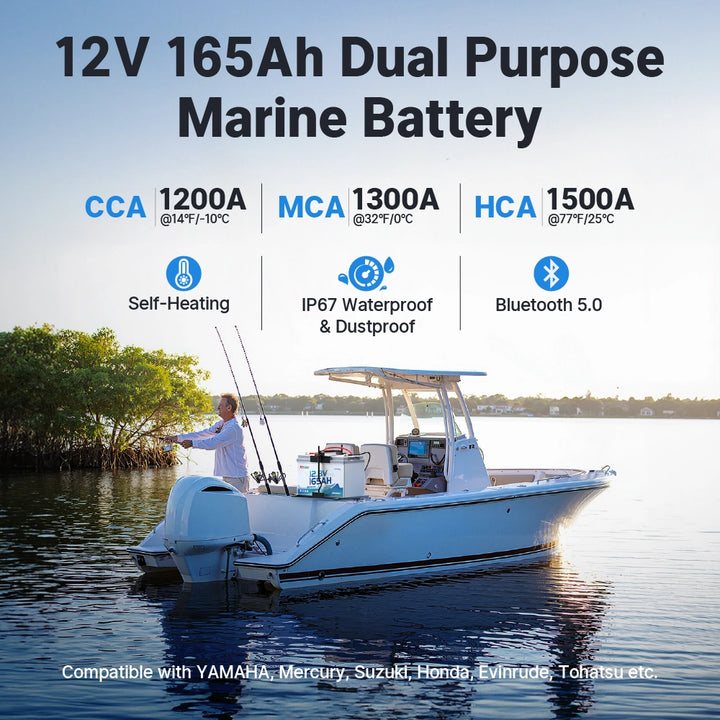
Redodo 12V 165Ah Dual-Purpose Marine Battery
Marine Battery Chemistry: Lead-Acid vs Lithium
Battery chemistry plays a major role in determining how a marine battery performs over time, how much maintenance it requires, and how suitable it is for specific boating applications.
While lead-acid batteries have been the traditional choice for decades, lithium batteries are rapidly gaining popularity due to advances in safety, efficiency, and durability.
Lead-Acid Marine Batteries (FLA, AGM, Gel)
Lead-acid batteries have been used in marine applications for decades and remain a common choice, due to their relatively low upfront cost and widespread availability. They are easy to source, compatible with most traditional marine charging systems, and familiar to many boat owners.
For light-duty or occasional boating, lead-acid batteries can still provide adequate performance. However, lead-acid batteries come with several inherent limitations:
- Usable capacity: In most cases, only about 50% of usable capacity.
- Maintenance burden: Lead-acid batteries may require periodic inspection and proper ventilation. Sulfation and capacity fade are common in marine environments.
- Weight: Lead-acid batteries are much heavy, which can affect boat balance, fuel efficiency, and installation flexibility.
- Lifespan: Their service life is typically limited to 2-5 years.
Lithium Marine Batteries (LiFePO4)
Lithium (LiFePO4) batteries represent a newer generation of marine energy storage and are increasingly considered the best option for modern boats. For boaters who prioritize performance, reliability, and long-term value, lithium batteries are increasingly the preferred marine battery chemistry.
The benefits of lithium marine batteries:
- More usable capacity: They can safely be discharged to a much deeper level, often close to 80-100% of the rated capacity.
- Consistent power delivery: Voltage output remains stable throughout the discharge cycle, especially beneficial for trolling motors and fish finders.
- Weight reduction: Lithium batteries are significantly lighter than lead-acid batteries with the same rated capacity.
- Longer lifespan: High-quality LiFePO4 batteries can reach over 4000 cycles, lasting 2-3 times longer than lead-acid batteries.
While lithium boat batteries have a higher initial purchase price, their long service life, minimal maintenance, and superior efficiency often result in a lower total cost of ownership over time.

What Size Marine Battery Do You Need?
Choosing the correct marine battery size is one of the most common pain points for boat owners. A battery that is too small will result in short runtimes and frequent recharging, while an oversized battery may add unnecessary weight and cost.
Battery sizing should always be based on how much power you use, how long you need it, and how your boat’s electrical system is configured.
Battery capacity is often confused with battery group size, but they are not exactly the same. Let’s explore these two concepts in details.
Battery Group Size
Marine batteries are commonly classified by BCI (Battery Council International) group size. Group size primarily refers to the battery’s physical dimensions and terminal layout, not its capacity. However, larger group sizes typically mean more higher capacity.
For marine applications, the most common group sizes include Group 24, Group 27, and Group 31.
- Group 24 batteries: Compact and easier to fit into small compartments, making them suitable for basic electronics or engine starting.
- Group 27 batteries: Offer a balance between size and capacity and are often used for trolling motors or moderate house loads.
- Group 31 batteries: Larger and heavier, but provide the longest runtime and are well-suited for high-demand systems.
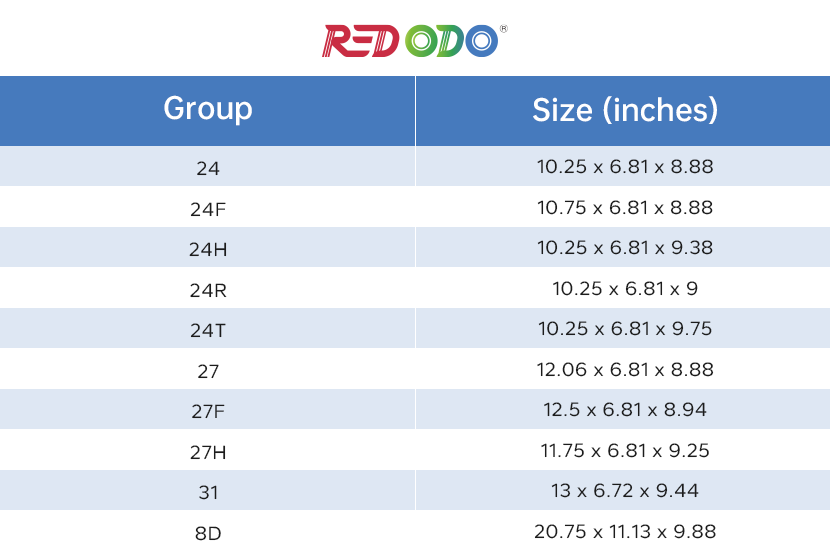
Before selecting a group size, it is essential to measure your battery tray or compartment and confirm terminal orientation. Even a high-capacity battery is unusable if it does not physically fit your boat.
Related Reading: Group 24 VS Group 31 Deep Cycle Batteries
Group 24 vs. Group 27 Marine Batteries
Battery Capacity (Ah)
Battery capacity is measured in amp-hours (Ah), which indicates how much current a battery can deliver over time. To estimate your required capacity, start by listing all the devices you plan to power and how long you expect to use them.
For example, trolling motors, fish finders, chartplotters, lighting, pumps, and inverters all draw different amounts of current. When these loads run simultaneously or for extended periods, total consumption can add up quickly.
As a general guideline, smaller boats with minimal electronics may only require 50-100Ah. Boats with trolling motors or extended fishing sessions often need 100-200Ah or more. For cruisers, sailboats, or off-grid setups that rely on refrigeration and inverters, 200Ah and above is common.
For trolling motor batteries (marine batteries used exclusively for trolling motors), the capacity should be chosen based on the trolling motor's thrust. Below are the recommended battery setups with different thrust levels.
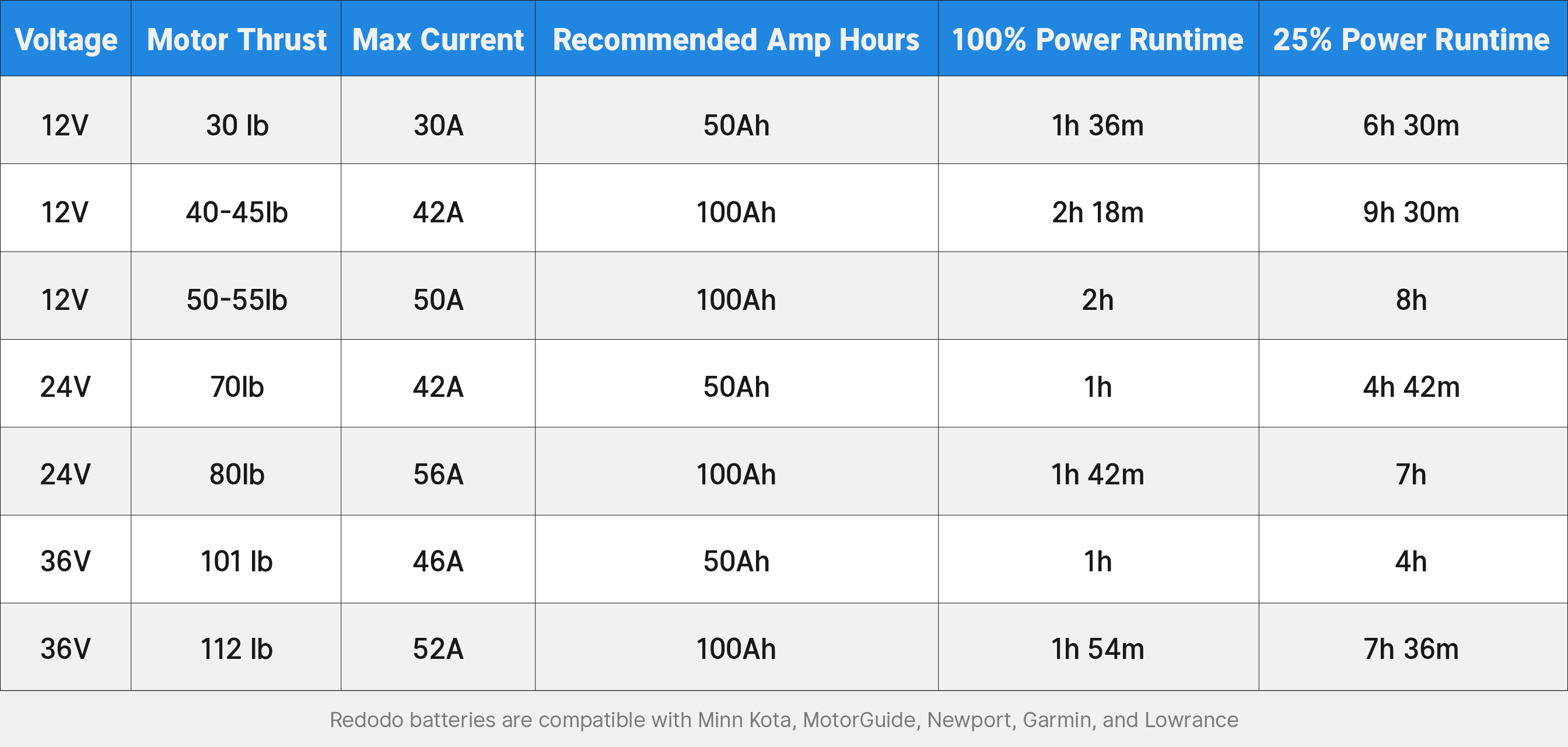
Related Reading: What Size Battery for Trolling Motor?
Single Battery vs Battery Bank
Some boats rely on a single battery, while others use multiple batteries connected together to form a battery bank. Battery banks are often used to increase capacity, increase system voltage, or separate engine starting from house power.
Wiring batteries in parallel increases total capacity while maintaining the same voltage. Wiring batteries in series increases voltage while keeping capacity the same.
Lithium batteries simplify battery banks by reducing weight, improving efficiency, and minimizing voltage imbalance issues that are common with lead-acid systems.
Related Reading: Batteries in Series vs Parallel
Marine Battery Voltage Systems: 12V, 24V, or 36V
Marine electrical systems are commonly built around 12V, 24V, or 36V configurations. The correct voltage depends on the size of your boat, the power demands of your equipment, and the efficiency you want from your system.
12V Marine Systems
12-volt systems are the most common and simplest option. They are widely used on small boats, pontoons, and basic fishing vessels. Most marine electronics, lighting, and accessories are designed to operate on 12V power, making system integration straightforward.
While 12V systems can become inefficient as power demand increases. Therefore, a 12V system is not suitable for higher power boats.
24V Marine Systems
24-volt systems are commonly used for mid-sized trolling motors and boats with higher electrical loads. By doubling the voltage, current is reduced, which improves efficiency and minimizes voltage drop. This allows motors and electronics to operate more effectively, especially over longer distances.
Many anglers prefer 24V systems because they provide longer runtimes and smoother motor performance compared to 12V setups. They typically require two batteries wired in series or a dedicated 24V lithium battery.
36V Marine Systems
36-volt systems are designed for high-thrust trolling motors and demanding offshore or tournament-level fishing applications. These systems offer maximum efficiency, reduced current draw, and superior performance under heavy loads.
Although 36V systems require more planning and higher initial investment, they are ideal for large boats that need long runtimes and precise motor control. Lithium batteries have made 36V systems more practical by reducing overall weight and simplifying installation.
| Voltage of Motor | Motor Thrust | Recommended Battery Setup |
|---|---|---|
| 12V | 20–30 lbs | 12V 50Ah trolling motor battery |
| 30–70 lbs | 12V 100Ah batteries | |
| 24V | 70–100 lbs | 24V 50Ah trolling motor battery |
| 70–100 lbs | 2 × 12V 100Ah batteries in series | |
| 36V | 100–120 lbs | 36V 50Ah trolling motor battery |
| 100–120 lbs | 3 × 12V 100Ah batteries in series |
Choosing the Right Voltage System
When deciding between 12V, 24V, and 36V, consider motor requirements, available space, cable length, and future upgrades.
Higher-voltage systems are generally more efficient and scalable, especially when paired with lithium batteries. Choosing the correct voltage upfront can prevent costly rewiring and system changes later.
Matching the Best Marine Battery to Your Use Case
Redodo provides a wide range of lithium batteries for different marine purposes. These LiFePO4 batteries have a long cycle life, lightweight performance, and robust marine-ready designs, making them excellent options for many boating applications.
Below are detailed use-case breakdowns with recommended marine batteries that align with those needs.
Best Marine Battery for Trolling Motors
For trolling motors, deep cycle performance matters more than cranking power. A deep-cycle lithium battery with plenty of amp-hours provides long run times and responsive power delivery.
Recommended:
- 12V 100Ah Lithium Trolling Motor Battery: One battery replaces two 12V 100Ah AGM batteries, providing double runtime while saving 2/3 weight. → Shop Now
- 12V 100Ah Group 24 Bluetooth Lithium Battery: A versatile 100Ah battery ideal for most 12V trolling motors, combining deep-cycle performance with compact Group 24 size. → Shop Now
- 12V 140Ah Group 31 Bluetooth Lithium Battery: Offers extra capacity for longer runs or higher-draw motors, great for extended fishing trips. → Shop Now
- 12V 165Ah Group 31 Bluetooth Lithium Battery: A higher-capacity option with Bluetooth for advanced monitoring; excellent for multiple devices or longer sessions. → Shop Now
Best Marine Battery for Engine Starting
When selecting a marine battery for engine starting, cold cranking amps (CCA) are the most critical factor to consider, as they determine whether the battery can reliably deliver the high burst of power required to start your engine.
Recommended:
- 12V 20Ah Marine Starting Lithium Battery: 800 CCA, compact starter battery that delivers reliable starting power for engines. → Shop Now
- 12V 100Ah Group 27 Marine Dual-Purpose Battery: 900 CCA, compatible with all outboard motors; combines engine starting and deep-cycle power. → Shop Now
- 12V 165Ah Group 31 Marine Dual-Purpose Battery: 1200 CCA, higher capacity for longer runtime. → Shop Now
Best Marine Battery for House Power
Marine house batteries support onboard systems such as refrigerators, lighting, navigation equipment. A larger-capacity deep cycle battery or battery bank gives dependable capacity to ensure you navigate the seas with confidence.
Recommended:
- 12V 200Ah Low-temp Lithium Battery: 2560Wh of energy to support extended accessory use; low-temp protection for cold climate. → Shop Now
- 12V 300Ah Lithium Battery: 3084Wh of energy, great for larger vessels or heavy house loads; its high capacity means fewer cycle interruptions. → Shop Now
- 12V 320Ah Mini Bluetooth Lithium Battery: 4096Wh of energy, combines massive capacity with Bluetooth monitoring; ideal for solar, longer trips, and off-grid power. → Shop Now
Best Marine Battery for Fish Finders & Ice Fishing
Fish finder batteries provide stable and reliable power for smaller, specialty electronics like fish finders, livescope, GPS, and sonar systems. These devices need steady power but don’t draw huge current.
Recommended:
- 16V 30Ah Lithium Fish Finder Battery: Higher-voltage battery designed for fish finders with excellent images and reliability. → Shop Now
- 12V 50Ah Bluetooth Lithium Battery: A compact Bluetooth-enabled battery that’s perfect for powering both fish finders and small electronics on fishing trips. → Shop Now
Best Marine Battery for Outboard Motors
The outboard motor batteries power electric outboards or high-draw trolling setups, and maintain consistent voltage under load.
- 12V 100Ah Plus Outboard Motor Bluetooth Battery: Designed specifically with electric outboard motors in mind, offering surge resistance, Bluetooth monitoring, and long cycle life to handle tougher loads. → Shop Now
Related Reading: 8 Best Lithium Marine Batteries Depth Review
FAQs
What type of battery is a marine battery?
A marine battery is specifically designed for boating environments and typically falls into starting, deep-cycle, or dual-purpose categories, with modern options available in both traditional lead-acid and advanced lithium chemistries.
How long will a trolling motor battery last?
The runtime of a trolling motor battery depends on battery capacity (amp-hours), motor thrust, speed settings, and water conditions; in general, a 100Ah lithium battery can power a trolling motor for 4–8 hours of typical use, while larger capacities or higher-voltage systems can extend runtime significantly.
Can you use a car battery for a trolling motor?
While a car battery may power a trolling motor briefly, it is not recommended because car batteries are designed for short, high-current bursts rather than sustained discharge, which can lead to reduced performance and premature battery failure.
Are lithium batteries good for trolling motors?
Yes, lithium batteries are excellent for trolling motors because they provide stable power, deeper usable discharge, faster charging, and significantly longer cycle life compared to traditional lead-acid batteries.
Final Verdict: What Is the Best Marine Battery?
There is no single “best” marine battery for everyone—but there is a best option for your boat and usage.
In general:
- For engine starting: Marine starting battery or lithium cranking battery
- For trolling motors and electronics: Lithium deep cycle battery
- For house power: High-capacity AGM or lithium battery
If you value lightweight design, long lifespan, and consistent performance, LiFePO4 lithium batteries are the best marine battery choice for most modern boats.
Choosing the right marine battery upfront means fewer headaches, longer days on the water, and power you can rely on trip after trip.

Redodo
Redodo
Join Redodo
Related Post

What Are Street Legal Requirements for Golf Carts?

What is SOC in Lithium Battery and Why Does It Matter?

Best Portable Battery for Overlanding 2026: Buyer’s Guide

How to Live in an RV Full-Time: A Complete Beginner’s Guide

How To Test a Battery with a Multimeter? (Step-by-Step)
Related Products


Redodo 12V 100Ah Group 24 Bluetooth LiFePO4 Battery | Real-Time Battery Monitoring | For RV, Marine, Solar

🎃【SAVE $20】Redodo 12V 100Ah Ultra-Mini Lithium LiFePO4 Battery | Smallest Bluetooth Battery | For RV, Trolling Motor, Solar


🎃【SAVE $20】Redodo 24V 50Ah Bluetooth Lithium Trolling Motor Battery | For 24V Trolling Motors with up to 100 lbs

🔥【SAVE $40】Redodo 12V 100Ah 900 CCA Group 27 Dual Purpose Marine Battery with OTA Bluetooth Auto-Heating

Redodo 36V 50Ah Lithium Trolling Motor Battery for 36V Trolling Motors with 100-120 lbs

🎃【SAVE $40】Redodo 12V 165Ah 1200 CCA Group 31 Dual-Purpose Lithium Marine Battery | Starting • Trolling • Electronics— All from One