The Complete Guide to Power Your Spring Camping & Fishing Trips
Spring is the perfect time to explore the outdoors—whether you’re heading out for spring camping in the mountains, parking your RV beside a quiet lake, or chasing bass during the early spring bass fishing season.
However, all outdoor activities rely on a reliable power system. Choosing the right power system can make the difference between a smooth off-grid adventure and constant power anxiety.
This guide will help you learn everything about building a reliable energy setup for your RV camping setup and bass fishing boats, and understand how to choose the best battery for RV marine use.
Table of Content
Part 1. Battery Power System Basics: Voltage, Capacity, and Types
Before choosing batteries for RV camping or fishing trips, it’s important to understand the basic terms used in battery systems.
Voltage (V)
Voltage represents the electrical pressure that pushes current through a system. It determines how strongly electricity flows from the battery to your devices.
Common voltage systems used outdoors include:
| System | Common Uses |
|---|---|
| 12V Battery | RV systems, small boats, fish finders |
| 24V Battery | Larger boats, 24V trolling motors |
| 36V Battery | High-power boats, 36V trolling motors |
Most RV electrical systems operate on 12V, while fishing boats often use 24V or 36V systems for trolling motors.
Note: LiFePO4 batteries typically have a nominal voltage of 12.8V, while traditional lead-acid batteries are rated at 12V.
Capacity: Amp Hours (Ah) vs Watt Hours (Wh)
Battery capacity tells you how much energy a battery can store and how long it can power your devices. Two common units are used to describe battery capacity: amp hours and watt hours.
Amp Hours (Ah)
Amp hours measure how much current a battery can deliver over time.
Example:
A 100Ah battery can deliver
- 10A for 10 hours
- 5A for 20 hours
However, Ah alone doesn't show the total energy. So, you need to convert Ah to Wh.
Watt Hours (Wh)
Watt hours represent the actual energy stored in a battery.
Formula:
Wh = Voltage × Ah
Example:
- A 12V 100Ah lithium battery delivers 1280Wh of energy
- A 12V 200Ah lithium battery delivers 2560Wh of energy
Wh is often a better metric when calculating daily power consumption for RV camping or fishing gear.
Related Reading: How to Calculate Watt Hours to Amp Hours?
Series vs Parallel Battery Connections
Outdoor power systems often require multiple batteries, especially when a single battery does not provide enough capacity. In many cases, the simplest solution is to add more batteries and connect them in parallel to increase the total capacity.
If you want to upgrade a 12V trolling motor system to 24V, two 12V batteries can be connected in series to achieve the higher voltage required by the motor.
Parallel Connection
Parallel connections increase capacity (Ah) while keeping voltage the same.
Example:
Two 12V 100Ah batteries in parallel = 12V 200Ah system
Common for:
- RV battery banks
- Solar storage systems
Series Connection
Series connections increase voltage while keeping capacity the same.
Example:
Two 12V 100Ah batteries in series= 24V 100Ah system
Common for:
- Trolling motors
- Electric boat propulsion
When connecting multiple batteries, make sure they are the same type, voltage, capacity, and BMS, and that they are of a similar age.
Related Reading: How to Connect Batteries in Series and Parallel?
Lead-Acid vs Lithium Batteries
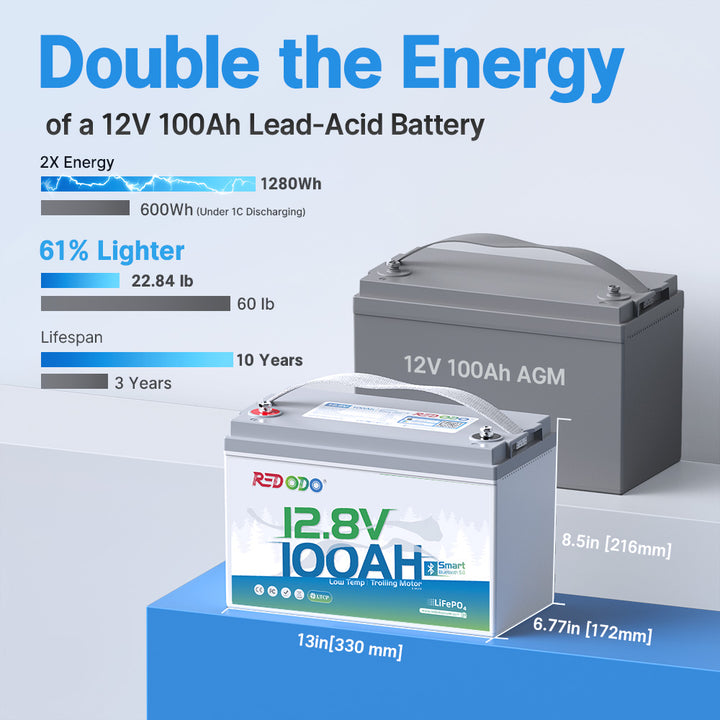
When choosing the best battery for RV camping or marine use, the most common comparison is between lead-acid batteries and lithium batteries (LiFePO4).
| Feature | Lead-Acid (FLA, AGM) | Lithium (LiFePO4) |
|---|---|---|
| Usable Capacity | ~50% | 90–100% |
| Lifespan | 300–500 cycles | 4000+ cycles |
| Weight | Heavy | 50–70% lighter |
| Charging Speed | Slow | Fast |
| Maintenance | Required | Maintenance-free |
Because of their long lifespan, lighter weight, and higher efficiency, lithium batteries are becoming the preferred option for RV camping and fishing boats.
Related Reading: AGM vs. Lithium Batteries: Which Is Better For RV And Marine
Part 2. RV Camping Power Systems
For travelers planning spring camping trips with an RV, the battery system is the heart of your off-grid power supply.
Common RV Battery Configurations
Most RVs rely on 12V house battery systems. These 12V RV batteries power interior lights, water pumps, RV refrigerators, fans and small appliances.
Typical RV camper setups include:
| RV Type | Typical Battery Setup |
|---|---|
| Small camper van | 100Ah lithium |
| Travel trailer | 200Ah lithium |
| Motorhome | 200–400Ah lithium |
| Large RV / fifth wheel | 300–600Ah lithium |
What Battery is Best for RV Camping?
The best battery for RV camping is lithium deep cycle batteries. Unlike vehicle starter batteries, RV batteries are designed to provide steady power for long periods. These are called deep cycle batteries.
Compared with traditional lead-acid batteries, lithium batteries offer significantly better deep-cycle performance, allowing them to deliver stable power over longer periods of time. This makes them ideal for RV camping and solar energy storage.
How to Choose the Best Battery for RV Camping?
When selecting a battery for RV camping trips, several factors matter.
1. Battery Capacity (Ah)
Capacity determines how long your battery can power your devices. If you frequently run appliances like refrigerators or AC, larger capacity is essential.
General recommendations:
- Weekend camping: 100Ah-200Ah
- Camping combo: 200Ah-300Ah
- Boondocking, Extended off-grid travel: 300Ah+
2. Weight and Space
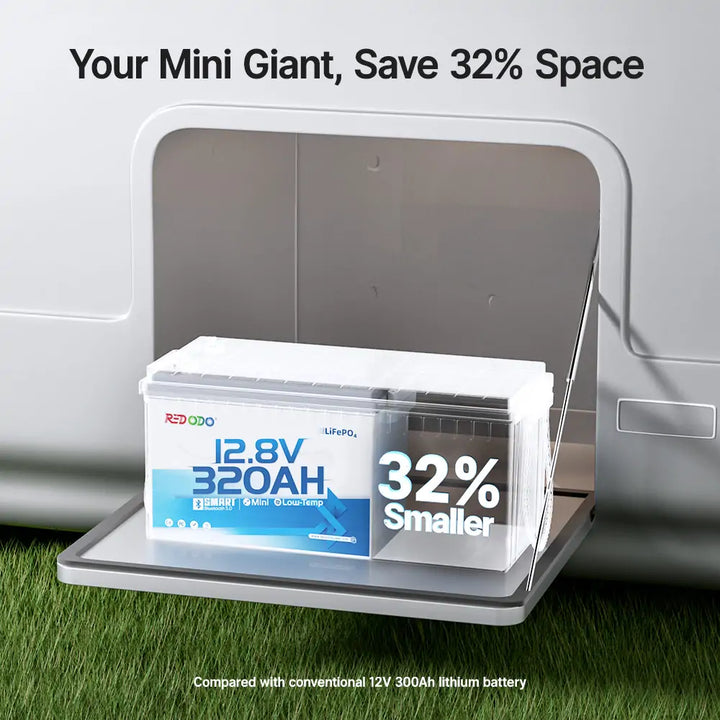
Space inside RV battery compartments can be limited. Lithium batteries can be up to 60% lighter than lead-acid batteries with the same capacity. This weight reduction is especially valuable when traveling long distances.
For users who want to save space in their RVs, choosing a compact battery design can be a major advantage, for example, Redodo 12V 100Ah Mini LiFePO4 Battery and the Redodo 12V 320Ah Mini Bluetooth Battery.
3. Safety Features
Modern lithium batteries often include Battery Management Systems (BMS) that protect against overcharging, over-discharging, overcurrent, short circuits, overheating. Some advanced BMS supports Bluetooth for real-time monitoring.
Related Reading: What is the Best RV Battery and How to Choose it?
How Many Batteries Do I Need for RV Camping?
It depends on your power consumption and your battery capacity. First, estimate your total daily RV energy usage. Then use the following formula to determine the battery capacity you need and how many batteries are required.
Required Amp Hours (Ah) = Total Watt Hours (Wh) ÷ 12V
Example:
If your RV consumes about 2.4 kWh (2400Wh) of electricity per day, then:
2400Wh ÷ 12V = 200Ah
In this case, you would need approximately one 12V 200Ah battery, or two 12V 100Ah batteries connected in parallel.
For most spring camping trips, a 200Ah lithium battery provides a comfortable power buffer.
Related Reading: How Many Batteries Do I Need in My RV?
Part 3. Fishing Boat Power Systems
Spring is one of the best times for bass fishing, as fish become active after winter and move into shallow waters.
If your trip includes spring bass fishing, your boat will likely require a different power setup than your RV.
Three Types of Marine Batteries
1. Marine Starting Batteries
Starting batteries are used to start the boat engine. They typically feature high cranking amps, delivering high bursts of power for a short period.
Redodo provides these marine starting battery options:
- 12V 20Ah Lithium Marine Starting Battery (800 CCA)
- 12V 100Ah Lithium Dual-Purpose Marine Battery (1000 CCA)
- 12V 165Ah Lithium Dual-Purpose Marine Battery (1200 CCA)
Tip: Dual-purpose marine batteries are designed to both start the boat engine and provide deep-cycle power for onboard electronics.
2. Marine House Batteries
House batteries power onboard electronics such as fish finders, GPS, lights, live wells, radios. Just like RV batteries, these are usually deep cycle batteries.
3. Trolling Motor Batteries
Trolling motor batteries are widely used in bass fishing because they provide a stable and consistent power for trolling motors that need quiet, precise boat control.
Lithium marine batteries are especially useful because they maintain stable voltage, which helps trolling motors, fish finders, and electronics perform smoothly and accurately. They also have the following advantages for boats:
- reduce boat weight
- more usable capacity
- charge faster
- longer lifespan
- maintenance-free

Redodo 12V 140Ah Bluetooth Group 31 lithium battery
How to Choose the Right Trolling Motor Battery?
When choosing the right trolling motor battery, consider the following factors.
1. Motor Voltage Requirements
Most trolling motors operate on 12V system, larger bass boats require 24V or 36V system, and your battery configuration must match the motor.
2. Battery Capacity (Amp Hours)
Battery capacity determines how long your trolling motor can run. Capacity is usually measured in amp hours (Ah). For anglers planning full-day trips, choosing a battery with higher capacity is recommended.
Related Reading: Trolling Motor Lithium Battery Runtime Guide
3. Battery Weight
Weight can significantly affect boat performance, especially for kayaks, small boats, or bass boats. Lithium batteries are often preferred because they are much lighter than traditional lead-acid batteries, which can improve boat balance, speed, and fuel efficiency.
What Size Trolling Motor Battery Do I Need?
Choosing the right battery size depends on three main factors:
- Motor voltage
- Motor thrust
- Expected runtime
A useful way to estimate battery capacity is to consider how much energy your trolling motor consumes.
Battery energy is calculated using the relationship between voltage and amp hours:
Battery Energy (Wh) = Battery Voltage (V) x Battery Capacity (Ah)
Larger batteries provide higher capacity and longer runtime, which is important for full-day fishing trips.
Recommended Battery Sizes for Trolling Motors
Below are general recommendations based on common fishing setups.
| Boat Type | Motor Voltage | Recommended Battery |
|---|---|---|
| Kayak | 12V |
12V 50Ah trolling motor battery 12V 100Ah trolling motor battery |
| Small fishing boat | 12V | 12V 100Ah trolling motor battery |
| Bass boat | 24V |
24V 50Ah trolling motor battery Two 12V 100Ah batteries |
| Large bass boat | 36V |
36V 50Ah trolling motor battery Three 12V 100Ah batteries |
Related Reading: What Size Battery for Trolling Motor?
Battery Maintenance Tips for Spring Outdoor Trips
Even the best battery systems need proper care.
1. Charge Batteries Before the Trip
Always start your trip with fully charged batteries.
2. Avoid Deep Discharge
For lead-acid batteries, try not to drop below 50% capacity. Lithium batteries allow deeper discharge but still last longer if kept above 10–20%.
3. Protect Batteries from Cold
Spring nights and mornings can still be cold. Low temperatures may affect charging performance. Choose batteries with low-temperature charging protection when possible.
4. Store Batteries Properly After the Trip
If your camping season has long breaks:
- Store batteries at 50–70% charge
- Keep them in a dry environment
- Avoid extreme temperatures
Related Reading: How to Store LiFePO4 Batteries
Conclusion
Combining RV camping and fishing trips in the spring is one of the best ways to enjoy the outdoors. But to make your trip comfortable and stress-free, you need a reliable power system.
Understanding the basics of battery voltage, capacity, and wiring, choosing the best battery for RV camping, and building a proper fishing boat power system will ensure your equipment works when you need it most.
With the power supply preparation, you can focus on what matters most—exploring the outdoors, enjoying peaceful campsites, and making the most of the spring season.

Redodo
Redodo
Join Redodo
Related Post

What is SOC in Lithium Battery and Why Does It Matter?

Best Portable Battery for Overlanding 2026: Buyer’s Guide

How to Live in an RV Full-Time: A Complete Beginner’s Guide

How To Test a Battery with a Multimeter? (Step-by-Step)

5 Best 48V Lithium Batteries for Golf Cart in 2026
Related Products

🔥【SVAE $63】Redodo 12V 320Ah Mini Bluetooth Lithium Battery | Best for Boondocking, Long Road Trip, Desert Trip, Home Backup

⚡【Falsh Sale】Redodo 24V 50Ah Bluetooth Lithium Trolling Motor Battery | For 24V Trolling Motors with up to 100 lbs

⚡【Falsh Sale】Redodo 36V 50Ah Lithium Trolling Motor Battery for 36V Trolling Motors with 100-120 lbs

⚡【Flash Sale】Redodo 12V 100Ah Group 24 Bluetooth LiFePO4 Battery | Real-Time Battery Monitoring | For RV, Marine, Solar

⚡【Flash Sale】Redodo 12V 100Ah Lithium Trolling Motor Battery With Low Temp Protection

Redodo 12V 100Ah Group 31 Bluetooth Lithium Battery | Real-Time Battery Monitoring | For RV, Marine, Solar

⚡【Falsh Sale】Redodo 12V 165Ah 1200 CCA Group 31 Dual-Purpose Lithium Marine Battery | Starting • Trolling • Electronics— All from One

⚡【SAVE $35】Redodo 12V 100Ah 900 CCA Group 27 Dual Purpose Marine Battery with OTA Bluetooth Auto-Heating