Best Portable Battery for Overlanding 2026: Buyer’s Guide
Overlanding takes you beyond campgrounds and electrical hookups, but essentials such as a 12V refrigerator, lights, phones, cameras, fans, and communication equipment still need dependable power. Choosing the best portable battery for overlanding helps you stay off-grid without adding unnecessary weight or complexity to your vehicle.
For most weekend travelers, a 12V 100Ah LiFePO4 battery offers the best balance of usable energy, size, weight, and lifespan. A 50Ah battery works for lighter loads, while 200Ah to 300Ah+ systems are better for multi-day trips or appliances with higher energy demands.
What Is an Overland Battery Setup?
An overland battery setup is an auxiliary power system that runs camping equipment without discharging the vehicle’s starter battery. It can be as simple as one portable battery or as comprehensive as a permanently installed battery bank with alternator and solar charging.

Main Components of an Overland Battery Setup
A typical system contains:
- Starter battery: Starts the engine and powers the vehicle’s factory electronics.
- DC-DC charger: Uses alternator power to charge the auxiliary battery safely while driving.
- House battery: Stores energy for camping equipment.
- Fuse box: Distributes protected 12V power to appliances.
- Inverter: Converts DC electricity into AC power when household outlets are needed.
- Solar system: Provides optional charging while the vehicle is parked.
The house battery should remain electrically managed separately from the starter battery. This reduces the risk of waking up at a remote campsite with insufficient power to start the vehicle.
Portable Power Station vs. LiFePO4 Battery Bank
Both portable power station and lithium battery bank store energy, but they represent different system designs.
| Feature | Portable Power Station | LiFePO4 Battery Bank |
|---|---|---|
| Design | Battery, inverter and outlets in one unit | Modular battery-based system |
| Setup | Plug-and-play | Requires separate charging and distribution components |
| Portability | Easy to move | Can be portable or permanently mounted |
| Expandability | Often limited to compatible brand accessories | Flexible when properly designed |
| Best use | Short trips and temporary power | Regular or extended overlanding |
A portable power station prioritizes convenience. A LiFePO4 battery bank offers greater control over capacity, charging and power distribution. Redodo lithium batteries provide the storage foundation for a customized overland battery bank.
Some overlanders also combine both options rather than choosing only one. They use a LiFePO4 house battery for the fridge, lights and water pump, while keeping a portable power station for phones, laptops or equipment used away from the vehicle. You can also charge the portable power station through the lithium battery for extended life.
Why Choose a LiFePO4 Battery for Overlanding?
LiFePO4 batteries are a strong choice for overlanding because they combine high usable capacity, relatively low weight, stable voltage and long cycle life. These characteristics make them well suited to repeated off-grid use.
LiFePO4 vs. AGM Batteries
| Factor | LiFePO4 | AGM |
|---|---|---|
| Weight | Lighter at comparable capacity | Heavier |
| Usable capacity | Typically higher | Usually limited to avoid deep discharge |
| Cycle life | Longer | Shorter |
| Voltage output | Remains relatively stable | Drops more noticeably during discharge |
| Initial cost | Higher | Lower |
| Best suited to | Regular off-grid travel | Occasional use and lower budgets |
| Compatibility | Need a compatible charger or DC-DC system | Work with old lead-acid charging systems |
AGM remains a workable option for occasional trips. However, LiFePO4 usually provides better long-term value for travelers who frequently cycle their batteries.
Key Benefits for Overland Travel
A LiFePO4 battery reduces the weight required to carry a given amount of usable energy. Its stable voltage also supports refrigerators, lights and other 12V equipment more consistently as the battery discharges.
Most modern LiFePO4 batteries include a battery management system, or BMS, that monitors electrical and temperature conditions. Models with Bluetooth monitoring can make it easier to check the state of charge without adding a separate display.
What Is the Best Portable Battery for Overlanding?
The best portable battery for overlanding depends primarily on daily consumption and the number of days between charges. For most users, 100Ah is the practical starting point, while lighter or longer trips may justify a smaller or larger battery.
Best for Light and Emergency Use: 50Ah LiFePO4 Battery
Redodo 12V 50Ah battery stores approximately 640Wh and is suitable for LED lights, phones, cameras and other low-power equipment. Its lower weight makes it easy to carry between a vehicle, tent or portable battery box.
Key features:
- Approximately 640Wh of stored energy
- Lower weight than larger-capacity batteries
- Easier to carry and store in compact vehicles
- Suitable for lights, electronics and emergency backup
- Compatible with portable battery boxes
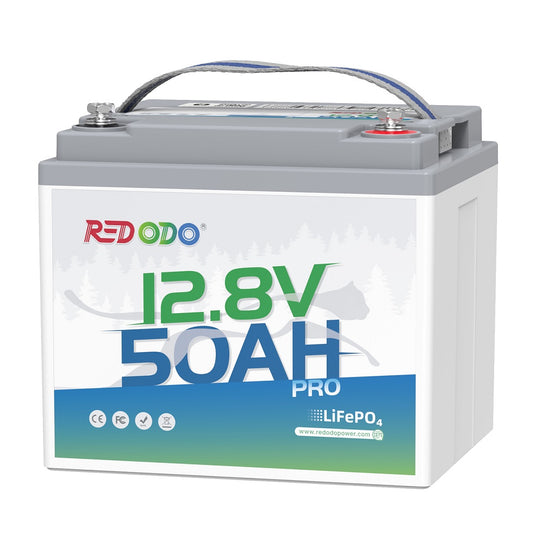
A 50Ah battery may be restrictive if a refrigerator must run continuously without solar or alternator charging. Travelers prioritizing a lightweight system can compare Redodo’s 12V LiFePO4 batteries.
Best Overall for Weekend Overlanding: 100Ah LiFePO4 Battery
For most weekend travelers, a 100Ah model is the best battery for overlanding. A nominal Redodo 12.8V 100Ah battery stores about 1,280Wh, providing a balanced starting point for a refrigerator, lights, phone charging and other small electronics.
For example, a camper reported that he useed a 100Ah lithium battery to run a fridge, lights, phones and laptops for three to four days without solar.
Key features:
- Approximately 1,280Wh of nominal energy
- Suitable for a 12V refrigerator, lights, phones and small electronics
- Balanced capacity for weekend travel
- More portable than 200Ah or 300Ah batteries
- Available in compact designs for space-limited vehicles
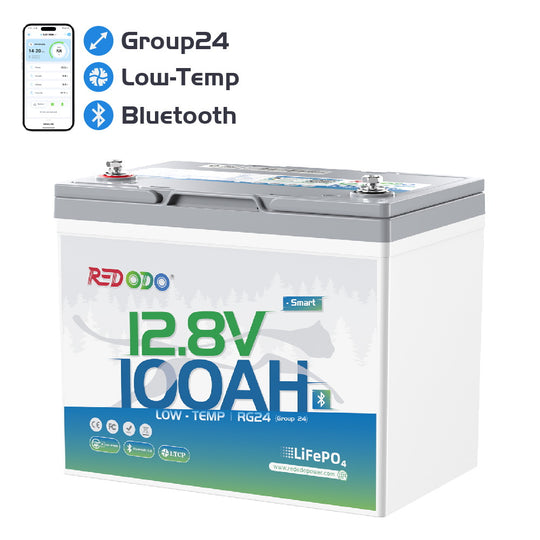
Where installation space matters, the Redodo 12V 100Ah Ultra-Mini Bluetooth battery combines the same nominal energy class with a more compact format and app-based monitoring.
Best for Multi-Day Trips: 200Ah LiFePO4 Battery
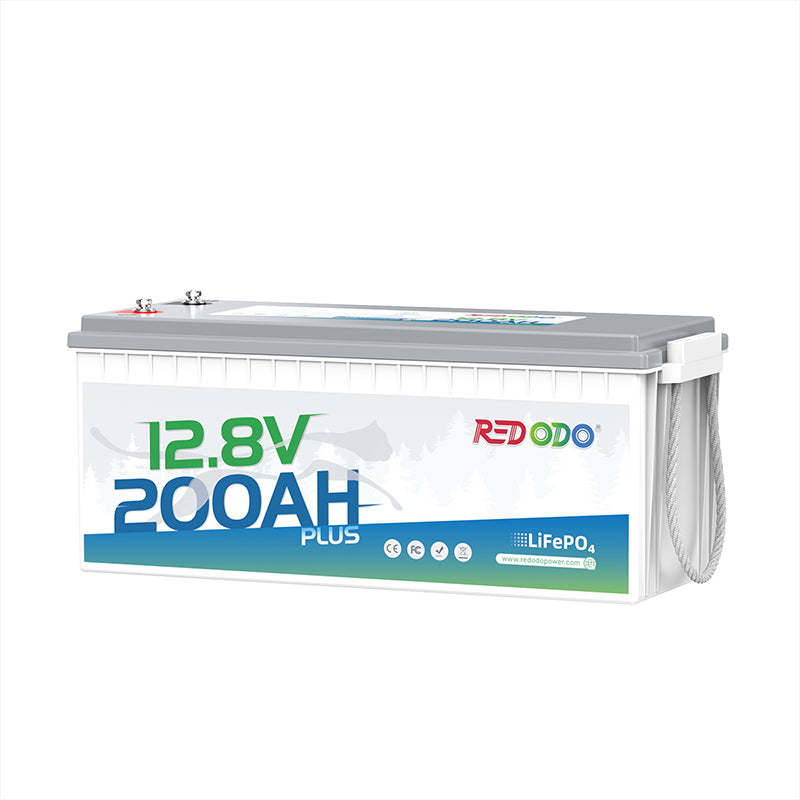
Redodo 12.8V 200Ah LiFePO4 battery stores approximately 2,560Wh, making it suitable for running a 12V refrigerator, lights, fans, laptops and other electronics during longer overlanding trips. The additional capacity also provides a useful buffer when cloudy weather reduces solar output or charging is unavailable.
Key features of the Redodo 12V 200Ah Plus:
- 2,560Wh of nominal energy
- 200A BMS for up to 2,560W of continuous output
- Suitable for higher daily consumption
- Longer runtime between charging sessions
- Expandable for larger overland battery setups
However, actual runtime depends on appliance consumption and charging input, while the larger capacity requires more installation space and charging time than a 100Ah battery.
Best for Extended Off-Grid Travel: 300Ah+ Battery Bank
A 300Ah or larger battery is designed for extended stays, heavier appliance use or limited access to charging. These batteries are less convenient to carry frequently, but they can form a high-capacity overland battery bank for long-term travel.
The Redodo 12V 300Ah LiFePO4 battery provides 3.84kWh of nominal energy.It may support equipment such as Starlink, a larger inverter or multiple refrigeration devices, provided its BMS and system wiring can handle the load.
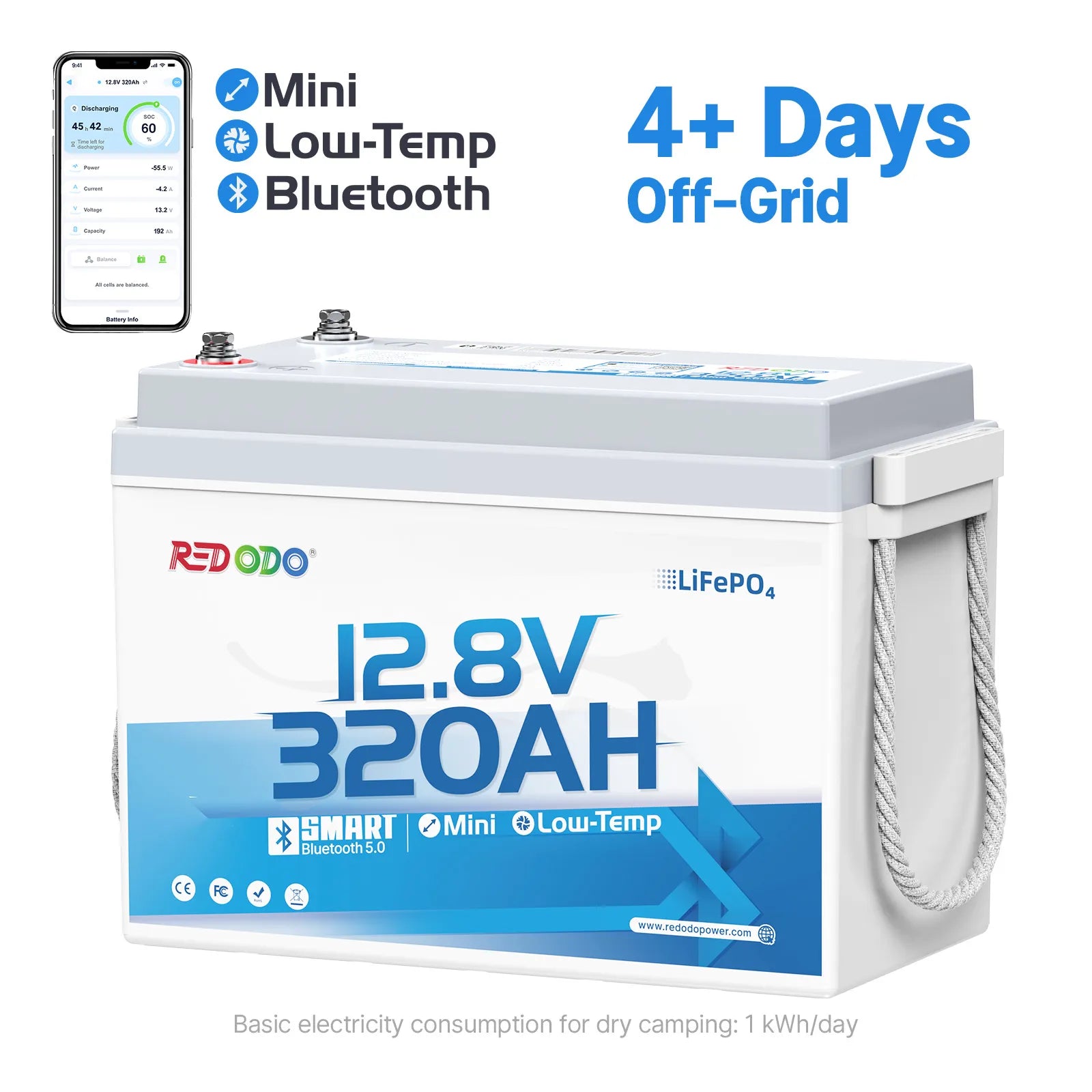
For greater capacity in a compact format, the Redodo 12V 320Ah Mini Bluetooth battery provides 4.096kWh of nominal energy. It is particularly suitable for travelers who need high capacity but have limited installation space.
Key features:
- 4,096Wh of nominal energy
- 200A BMS with up to 2,560W continuous output
- Compact Mini design for its capacity class
- Bluetooth monitoring for real-time battery data
- Low-temperature charging protection
A 300Ah+ battery bank should be planned as a complete system rather than selected by capacity alone. Charging power, inverter size, BMS output, cable gauge, fusing and available mounting space must all match the expected loads.
Recommended Battery Size by Use Case
| Use case | Suggested capacity | Typical loads |
|---|---|---|
| Day trips and backup power | 50Ah | Lights, phones and cameras |
| Weekend travel | 100Ah | Fridge, lights, fan and electronics |
| Multi-day travel | 200Ah | Fridge, laptops and multiple devices |
| Extended off-grid travel | 300Ah+ | Larger inverter loads and communication equipment |
These are recommendations rather than guaranteed runtime figures. Weather, appliance efficiency, temperature and available charging all change real-world performance.
How to Choose the Best Portable Battery for Overlanding?
Choose a battery for overlanding by evaluating energy consumption, runtime, physical space, charging access and environmental conditions. Before buying, use a battery monitor, shunt or ammeter to measure consumption over at least 24 hours. Real data will help you select the right capacity instead of relying on estimates alone.
Battery Capacity and Runtime
Battery capacity should cover your daily consumption for the required number of days between charges. Compare batteries and appliances in watt-hours rather than amp-hours alone because watt-hours account for system voltage.
Use these formulas:
Battery energy (Wh) = Voltage × Capacity (Ah)
Required battery energy (Wh) = Daily energy use (Wh) × Days between charges
Estimated runtime (hours) = Usable battery energy (Wh) ÷ Average load (W)
Appliance labels also do not always reflect daily consumption. A 40W refrigerator, for example, cycles on and off instead of drawing 40W continuously. Ambient temperature, ventilation, thermostat settings and door openings all affect runtime, so measured 24-hour consumption provides a more reliable basis for sizing.
Size and Portability
Measure the installation area before choosing capacity. Check battery length, width, height, weight, terminal position and the space required for cables.
A compact battery can preserve room for recovery gear, water and food. If the battery will be moved regularly, handles and a protected battery box are also important.
Charging Options
The best overland battery setup normally uses at least one reliable charging source:
- DC-DC charging replenishes the house battery while driving.
- Solar charging supports longer stays when the vehicle is parked.
- AC charging provides predictable charging at home or a powered campsite.
Every charger must use settings compatible with LiFePO4 batteries. Solar panels also require an appropriate charge controller; they should not be connected directly to the battery.
Solar can work well in open campsites but becomes far less dependable under trees or during cloudy weather. For this reason, many practical overland battery setups combine solar with alternator or AC charging instead of treating solar as the only source.
For a flexible, high-capacity solution, consider the Redodo 12V 320Ah LiFePO4 Upgrade Kit. It provides 4,096Wh of storage and supports solar, shore-power and alternator charging when paired with compatible equipment.

BMS and Low-Temperature Protection
Look for BMS protection against overcharge, over-discharge, overcurrent, short circuits and excessive temperature. The continuous discharge rating must also support the combined load.
Low-temperature charging protection is especially important for winter and high-altitude travel. It prevents charging when cell temperatures are unsafe. Self-heating is a separate feature that warms the cells before charging and may benefit users who regularly travel below freezing.
Durability and Weather Resistance
An overlanding battery may face vibration, dust, moisture and wide temperature changes. Check its enclosure, operating temperature range, terminal protection and available certifications.
Even a water-resistant battery should be securely mounted in a dry, protected location. Installation quality remains a variable: inadequate mounting, exposed terminals or undersized cables can undermine an otherwise capable battery.
How to Build an Overland Battery Setup
Before installation, identify whether the current setup charges from shore power, the vehicle alternator, solar or a combination of the three, and confirm that each charging path is compatible with LiFePO4.
A basic system connects a LiFePO4 house battery to a compatible charging device and fused distribution point:
Starter battery → DC-DC charger → LiFePO4 house battery → Fuse box/inverter → Appliances
A simple weekend system may need only a 100Ah battery, DC-DC charger and fuse box. Solar or an inverter can be added when the user’s measured energy demand justifies the extra equipment.
Use the fuse box for 12V loads and add an inverter only when AC power is required. Solar panels and an MPPT controller can be added for charging while parked. A broader selection of Redodo LiFePO4 batteries allows the system to be matched to the available space and expected runtime.
Exact fuse ratings, cable sizes and inverter capacity depend on maximum current and cable length. Have the system reviewed by a qualified installer if you are uncertain about vehicle wiring.
Frequently Asked Questions
What size battery is best for overlanding?
A 12V 100Ah LiFePO4 battery is a practical choice for most weekend trips. Choose 50Ah for light loads or 200Ah and above when running more equipment for several days.
Is a 100Ah battery enough for overlanding?
Yes, 100Ah is often enough for a refrigerator, lights, phones and other small devices during a weekend trip. Its suitability depends on actual daily consumption and whether alternator, solar or shore charging is available.
How long will a 100Ah battery run a 12V fridge?
A 12.8V 100Ah battery stores about 1,280Wh, but runtime depends on the refrigerator’s average consumption rather than its maximum wattage. Divide usable battery energy by measured daily consumption for a more reliable estimate.
Is a portable power station or LiFePO4 battery better for overlanding?
A portable power station is better for plug-and-play convenience. A LiFePO4 battery bank is usually better for a permanent, expandable system with customized charging and power distribution.
Can I Replace an AGM Battery with LiFePO4?
A physical battery swap may be possible, but the charging system must also be checked. Older converters, alternator connections and solar controllers may not fully charge a LiFePO4 battery or may not provide suitable charging control, so verify their lithium settings and output specifications before upgrading.
Conclusion
The best portable battery for overlanding is the one that matches your loads, trip length, vehicle space and charging opportunities. A 100Ah LiFePO4 battery is the best all-around starting point for weekend travel, while 200Ah to 300Ah+ options provide greater independence for longer journeys.
Redodo’s compact and expandable LiFePO4 battery range can form the core of anything from a lightweight portable setup to a high-capacity overland battery bank—helping you travel farther with dependable power behind every mile.

Redodo
Redodo
Join Redodo
Related Post

What Are Street Legal Requirements for Golf Carts?

What is SOC in Lithium Battery and Why Does It Matter?

Best Portable Battery for Overlanding 2026: Buyer’s Guide

How to Live in an RV Full-Time: A Complete Beginner’s Guide

How To Test a Battery with a Multimeter? (Step-by-Step)
Related Products


Redodo 12V 50Ah Lithium LiFePO4 Battery | For Portable Solar Power Stations, Camping, RV


Redodo 12V 100Ah LiFePO4 Lithium Battery | Best Budget | For RV, Solar, Trolling Motor

【Pre-Order】Redodo 12V 300Ah Lithium LiFePO4 Battery | Replaces 6*12V 100Ah AGM Batteries | For RV, Marine, Home battery backup