How to Charge a 48V LiFePO4 Lithium Battery?
As 48V LiFePO4 batteries become increasingly popular in solar energy systems, golf carts, RVs, marine setups, and off-grid power storage, more users are searching for the safest and most efficient charging methods. However, they require the correct charging equipment and settings to perform properly.
In this guide, we’ll explain how 48V LiFePO4 charging works, walk through the effective methods of charging 48V lithium batteries, and answer common questions about charger compatibility and charging times.
Takeaways
- A 48V LiFePO4 battery should always be charged with a compatible 48V lithium battery charger or a properly configured solar charging system.
- The recommended charging voltage for a 48V LiFePO4 battery is typically 56.8V–58.4V, depending on the battery manufacturer.
- Charging time depends on battery capacity, charger amperage, and the battery’s state of charge.
- Solar charging is an efficient off-grid charging solution when paired with an MPPT charge controller designed for lithium batteries.
- Using the wrong charger voltage, such as a 12V or 36V charger, will not properly charge a 48V battery and may damage the system.
Table of Content
Understanding 48V LiFePO4 Batteries
A 48V LiFePO4 battery is a lithium iron phosphate battery system commonly used in applications that require higher power output, longer runtime, and improved efficiency.
The 48V batteries are widely used in:
- Solar off-grid systems
- Golf carts
- Electric scooters and e-bikes
- Home backup power systems
Compared with traditional 48V lead-acid batteries, 48V LiFePO4 batteries offer longer cycle life, higher energy density and more stable performance.
How 48V LiFePO4 Battery Charging Works?
Unlike lead-acid and other lithium-type batteries, LiFePO4 batteries follow a specific charging profile.
Most 48V LiFePO4 batteries use a two-stage charging process:
Constant Current (CC) Stage
During the first stage, the charger supplies a steady current to the battery. The battery voltage gradually increases as energy is stored.
Constant Voltage (CV) Stage
Once the battery reaches its target charging voltage, the charger maintains a constant voltage while the charging current slowly decreases until the battery is fully charged.
For most 48V (51.2V) LiFePO4 batteries, the full charging voltage is approximately 56.8V to 58.4V.
A compatible 48V lithium battery charger is important because it follows the proper charging curve and communicates safely with the battery’s BMS.

Redodo 58.4V 18A Charger for 48V Lithium Batteries
How to Charge a 48V LiFePO4 Battery with a Charger?
The safest and most efficient method is using a dedicated 48V LiFePO4 battery charger. The following are the detailed steps:
Step 1: Verify Battery Specifications
Before charging your 48V lithium battery, check:
- Battery nominal voltage
- Recommended charging voltage
- Maximum charging current
- Battery capacity (Ah)
For example, a 48V 100Ah LiFePO4 battery usually requires a charger rated for 58.4V output.
Step 2: Use a Compatible Lithium Charger
Choose a charger specifically designed for LiFePO4 chemistry. Avoid using lead-acid chargers unless they have a dedicated lithium mode.
Step 3: Connect the Charger Properly
Turn off the battery-connected equipment.
Connect the charger’s positive cable to the battery positive terminal.
Connect the negative cable to the negative terminal.
Plug the charger into AC power.
Many modern lithium battery chargers automatically begin charging after detecting battery voltage.
Step 4: Monitor the Charging Process
During charging:
- Ensure proper ventilation
- Avoid high-temperature environments
- Check charger indicators
- Confirm the battery does not overheat
The built-in BMS usually disconnects charging automatically if unsafe conditions occur.
Step 5: Disconnect After Fully Charged
Once the charger indicates full charge, unplug the charger from AC power and disconnect the battery terminals. Store the battery properly if not in use.
Avoid leaving the charger connected for extended periods unless it supports lithium maintenance mode.
How Long Does It Take to Charge a 48V Battery?
The charging time of a 48V battery depends on these major factors: battery capacity (Ah) , charger amperage, and current battery state of charge (SOC).
A simplified charging formula is:
Charging Time (hours)= Charging Current (A) / Battery Capacity (Ah)
Common Charging Time Chart for 48V Batteries
| Battery Size | Charger Current | Estimated Charging Time |
|---|---|---|
| 48V 50Ah | 10A | 5 hours |
| 48V 100Ah | 20A | 5 hours |
| 48V 100Ah | 10A | 10 hours |
| 48V 200Ah | 40A | 5 hours |
| 48V 200Ah | 20A | 10 hours |
Actual charging time may vary slightly because the constant voltage stage slows charging near full capacity.
LiFePO4 batteries generally charge faster than lead-acid batteries due to their higher charging efficiency and lower internal resistance.
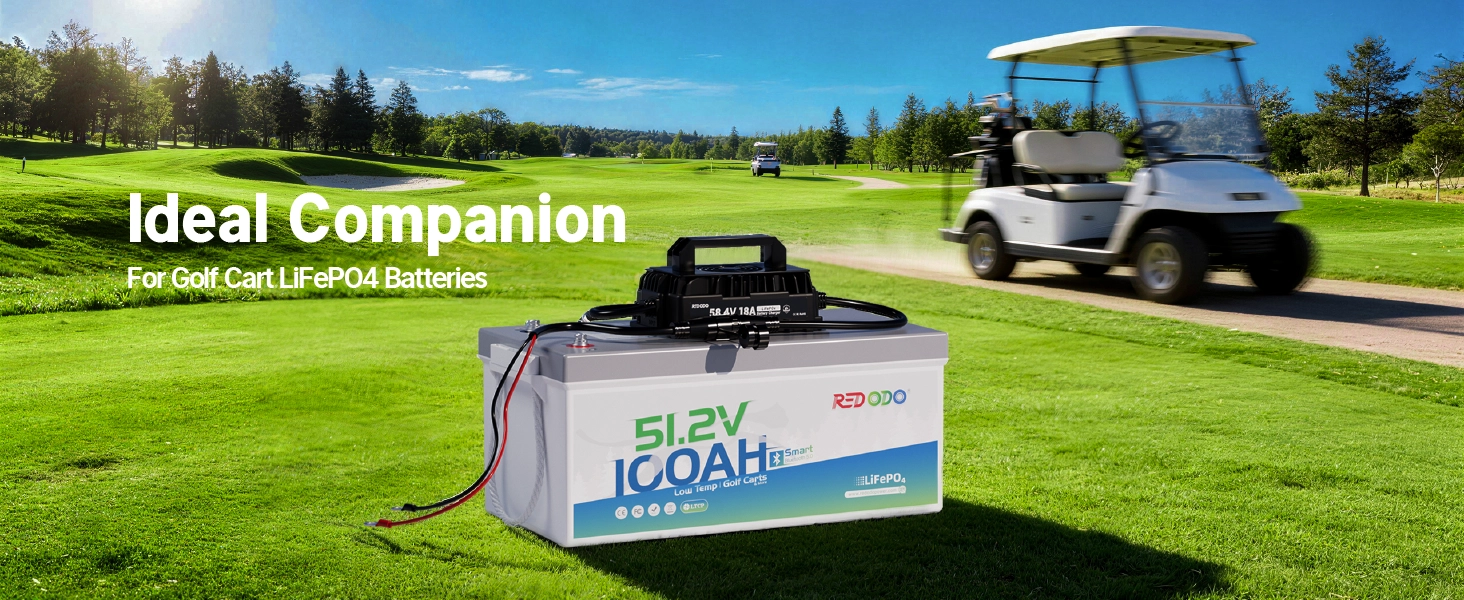
Redodo 48V Lithium Golf Cart Battery Charger
How to Charge a 48V Battery Without a 48V Charger?
If you do not have a dedicated 48V lithium charger, there are several alternative charging methods available.
Using Solar Panels to Charge a 48V Battery
A properly configured solar setup is one of the best alternatives for charging a 48V battery off-grid. This is especially common in RVs, cabins, and solar storage systems.
Required components include:
- Solar panels
- MPPT solar charge controller
- Proper wiring and fuse protection
Step 1: Connect Solar Panels to the Charge Controller
Wire the solar panels according to the controller’s voltage requirements.
Step 2: Configure Lithium Charging Parameters
Set the charge controller to LiFePO4 or custom lithium mode.
Typical settings include:
- Bulk/absorption voltage: 56.8V–58.4V
- Float voltage: Optional or disabled
- Low-temperature charging protection
Step 3: Connect the Battery
Connect the battery terminals to the charge controller with proper polarity.
Step 4: Monitor Charging Performance
Check solar input wattage, battery voltage, charging current, and temperature conditions.
Most modern MPPT controllers provide real-time monitoring through an LCD screen or mobile app.
Related Reading: How to Charge LiFePO4 Batteries with Solar?
Using a DC-DC Charger to Charge a 48V Battery
A DC-DC charger can convert power from another battery bank or alternator into suitable charging voltage for a 48V system. This method is commonly used in RVs, vans, boats, and off-grid setups where AC power is unavailable.
Some advanced users connect regulated power supplies in series to achieve the correct charging voltage. However, this method requires technical knowledge and is generally not recommended for beginners, because incorrect voltage balancing may damage the battery.
Step 1: Choose a Compatible DC-DC Charger
Select a DC-DC charger specifically designed to output the correct charging voltage for a 48V battery. The charger should support lithium charging profiles and match your input voltage source (such as 12V, 24V, or 36V input).
Step 2: Connect the Input Power Source
Connect the DC-DC charger input terminals to the source battery or alternator following the manufacturer’s wiring instructions. Install appropriate fuses and use properly sized cables for safety.
Step 3: Connect the 48V Battery
Connect the charger’s output terminals to the 48V LiFePO4 battery, ensuring correct polarity:
- Positive to positive (+)
- Negative to negative (-)
Step 4: Configure Lithium Charging Settings
If the charger has adjustable settings, select LiFePO4 mode or set the recommended charging voltage for your battery, typically 56.8V to 58.4V.
Step 5: Start Charging and Monitor Performance
Turn on the power source and verify that the charger begins charging normally. Monitor charging current, battery voltage, charger temperature, and system connections.
Step 6: Disconnect After Fully Charged
Once the battery reaches full charge, the DC-DC charger will usually reduce or stop the charging current automatically. Avoid leaving temporary charging setups connected for long periods, unless the DC-DC charger is specifically designed for continuous maintenance charging.
Important Reminder: Never attempt to charge a 48V lithium battery using an incompatible charger with incorrect voltage output. Improper charging can trigger BMS protection or permanently damage battery cells.
Related Reading: Do LiFePO4 Batteries Need a Special Charger?

FAQs about Charging 48V Batteries
Can a 12V or 24V charger charge a 48V battery?
No. A 12V or 24V charger cannot properly charge a 48V battery because the voltage is far too low. The battery management system may not even recognize the charger connection. Always use a charger specifically designed for 48V batteries.
Can a 36V charger charge a 48V battery?
No. A 36V charger does not provide enough voltage to fully charge a 48V battery. For example, most 48V LiFePO4 batteries charge between 56.8V to 58.4V, while a 36V LiFePO4 battery charger can only provide ~43.8V output voltage.
Can I charge a 36V battery with a 48V charger?
No. A 48V charger supplies much higher voltage than a 36V battery can safely handle. This may trigger BMS protection or permanently damage the battery cells. Always match charger voltage to battery voltage.
Do I need an inverter for charging 48V battery with solar panels?
No, you do not need an inverter to charge a 48V battery with solar panels in most situations. Since both the solar panels and the battery operate on DC power, an inverter is not required during the charging process. An inverter is only needed if you want to power AC appliances.
Conclusion
Knowing how to charge a 48V LiFePO4 lithium battery properly is essential for maximizing battery performance, lifespan, and safety. Whether you are using a dedicated lithium charger, a solar charging system, or an off-grid setup, proper voltage matching and charging control are critical.
The safest solution is a compatible 48V LiFePO4 charger designed specifically for lithium batteries. If you prefer renewable energy, learning how to charge a 48V battery with solar panel systems can provide reliable off-grid power for your applications.
By following proper charging procedures and avoiding common mistakes, your 48V LiFePO4 battery can deliver years of dependable performance.
Read More:
[Full Guide] How to Charge LiFePO4 Battery Safely?
How to Charge a 24V LiFePO4 Battery?

Redodo
Redodo
Join Redodo
Related Post

Best Prime Day LiFePO4 Battery Deals on RV, Boat, Solar & Golf Power

Big Prime Day Battery Deals 2026: Save 58% on Redodo LiFePO4 Batteries

What Is a BMS and Why Is It Important for Lithium Batteries?

Choosing The Best Lithium Batteries for Bass Boat

Portable Power Station vs. Deep Cycle Battery: Which is Better?
Related Products

🔥【Sale-$831 Only】Redodo 48V 100Ah Lithium Golf Cart Bluetooth Battery | Replaces 6x 8V(or 8x 6V) lead-acid batteries | For Club Car, EZGO, ICON, Yamaha

Redodo 48V 100Ah Bluetooth Golf Cart Lithium Battery Conversion Kit | For Club Car, EZGO, ICON, Yamaha


🔥【Final $807】Redodo 24V 200Ah LiFePO4 Lithium Battery | Trolling Motor, Marine, RV, Solar Home, Home Backup


Redodo 24V 50Ah Bluetooth Lithium Trolling Motor Battery | For 24V Trolling Motors with up to 100 lbs

🔥【$341 After Subscribe】Redodo 12V 165Ah Group 31 Bluetooth Lithium Battery | For RV, Marine, Solar Home

🔥【$230 After Subscribe】Redodo 12V 100Ah Group 24 Bluetooth LiFePO4 Battery | Real-Time Battery Monitoring | For RV, Marine, Solar

🔥【Sale-$245 Only】Redodo 12V 100Ah Group 31 Bluetooth Lithium Battery | Real-Time Battery Monitoring | For RV, Marine, Solar