What Size Battery Do I Need for a Travel Trailer?
When you're planning a travel trailer trip, whether it’s a weekend getaway or a long off-grid adventure, having the right battery is essential to keep everything running smoothly. From lights and water pumps to refrigerators and devices, your battery is the heart of your trailer’s power system.
However, one of the most common questions travel trailer owners ask is: what size battery for a travel trailer do I really need? In this guide, we’ll walk you through travel trailer battery sizes, learn how to calculate the amp-hour, and recommend suitable travel trailer batteries (including Bluetooth models) to meet your needs.
Table of Content
- What is A Travel Trailer Battery?
- What Type of Battery is Best for A Travel Trailer?
- What Does “Battery Size” Mean for a Travel Trailer?
- Calculating Travel Trailer Power Usage and Battery Capacity
- Typical Travel Trailer Appliance Power Usage
- Recommended Redodo Lithium Batteries for Travel Trailers
- Choosing the Right Battery Size Based on Your Camping Style
- FAQs of Travel Trailer Batteries
- Conclusion
What is A Travel Trailer Battery?
A travel trailer battery is a crucial component that provides electrical power to various systems within a travel trailer or camper. It’s not the engine starter battery; it’s the house battery that keeps daily living systems alive while you’re camping in your trailer.
These batteries come in different chemistries and sizes, and each type behaves a bit differently in how much usable energy it gives you, how much it weighs, and how long it lasts.
What Type of Battery is Best for A Travel Trailer?
There are three common types you’ll see in modern RVs and travel trailers: traditional lead-acid, AGM, and lithium deep cycle batteries.
- Traditional lead-acid: Often cheaper upfront, but heavier, requires more maintenance, and doesn’t give you as much usable energy when you discharge it deeply.
- AGM batteries: A sealed lead-acid that’s maintenance-free and more tolerant of vibrations, but still heavier and shorter-lived than lithium.
- Lithium batteries (LiFePO4): Offer longer life, lighter weight, faster charging, and a much deeper usable discharge, though they cost more up front.
For many travel trailer owners who camp off-grid or want longer dry-camping stays, lithium is increasingly the best overall choice. It delivers more usable capacity per amp-hour and reduces weight. That means you can carry less bulk for the same or greater runtime, and you don’t have to baby the battery as much to protect its life.

Redodo Lithium RV Batteries for Travel Trailers
What Does “Battery Size” Mean for a Travel Trailer?
When choosing the right size of travel trailer batteries, the “size” actually refers to two important things:
- Amp-Hours (Ah) – How much energy the battery can store
- Group Size (BCI Group) – The physical dimensions of the battery case
You need the right capacity to power your trailer, and the right physical size to make sure it fits in your battery compartment.
Understanding Amp-Hours (Ah)
Amp-hours (Ah) tell you how much energy a battery can store and how long it can deliver power to your travel trailer. The higher amp-hour rating, the longer your battery can run your appliances before needing to be recharged.
For example, a 12V 100Ah lithium battery can theoretically supply:
- 10 amps for 10 hours
- 5 amps for 20 hours
- 20 amps for 5 hours
However, real-world usage is never perfect. Power losses, inverter efficiency, temperature, and battery chemistry all affect actual performance. This is also why LiFePO4 lithium batteries are more efficient, because you can safely use 80–90% of their capacity, compared to only about 50% for lead-acid batteries.
Understanding Battery Group Size
Now that you know the battery capacity your travel trailer requires, the next step is choosing the right physical battery size. This ensures the battery fits properly in your battery box or battery compartment without any installation issues.
Travel trailer batteries are usually labeled by their Group Size, a standardized system set by the Battery Council International (BCI) that specifies the battery’s length, width, height, and terminal placement.
The most common group sizes for travel trailers include:
- Group 24 – Compact, lighter-duty
- Group 27 – Mid-size capacity
- Group 31 – Large, high-capacity
Before buying a battery, always check the battery compartment dimensions to ensure the new battery will fit properly. Measure the length, width, and height of the tray or compartment and compare it with the battery’s specifications.
Read More: Group 24 vs. Group 31 Deep Cycle Batteries
Calculating Travel Trailer Power Usage and Battery Capacity
Understanding how much power your travel trailer uses each day is the key to choosing the right battery size. RV owners typically use two calculation methods:
- Amp-Hour (Ah) Estimation Method
- Watt-Hour (Wh to Ah) Conversion Method
1. Amp-Hour (Ah) Estimation Method
This is the simplest and most commonly used method among RVers because most RV batteries are labeled in amp-hours. You simply estimate how many amp-hours each appliance uses per day, then total them up.
For example:
LED lights: 2–5Ah per night
Water pump: 3–6Ah per day
12V fridge: 30–60Ah per day
Fan: 15–25Ah per day
Phone charging: 5–10Ah per day
You’ll also consider the usable capacity of the battery. Lead-acid batteries keep only about 50% usable, while LiFePO4 lithium batteries can remain about 80–90% usable.
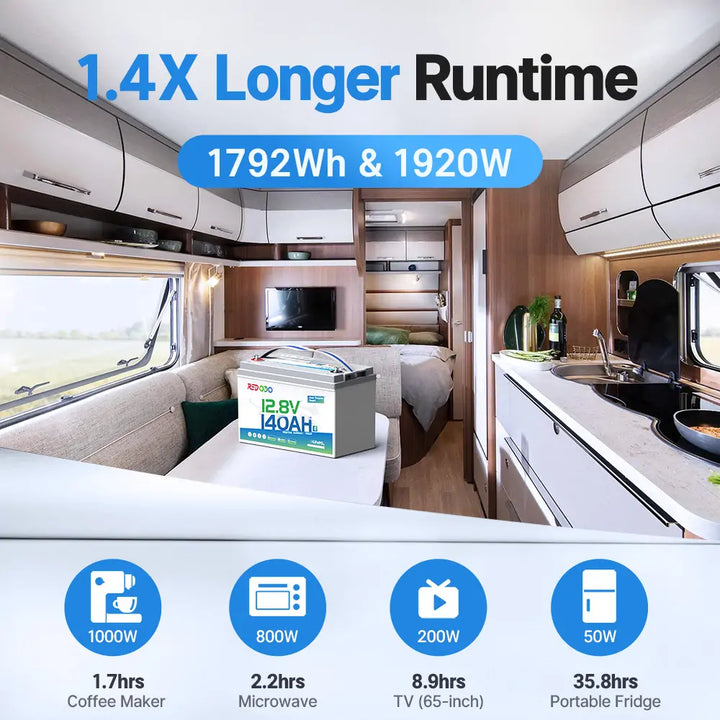
So if your total adds up to around 120Ah per day, you know you’ll need a 140Ah lithium battery or a 250–300Ah lead-acid battery.
2. Watt-Hour (Wh → Ah) Calculation Method
Some appliances list power in watts, not amps. In that case, you’ll need to convert watt-hours (Wh) into amp-hours (Ah) so you can match the battery size correctly.
The formula: Ah = Wh ÷ Battery Voltage (LiFePO4 for 12.8V, lead-acid for 12V)
This method is more accurate because it’s based on actual watt usage rather than generalized estimates.
For example:
If your roof vent fan is 36W, your 12V refrigerator is 60W and they run for 8 hours:
36W × 8h = 288Wh
60W × 8h = 480Wh
For a 12V lithium battery: (288Wh + 480Wh) ÷ 12.8V = 60Ah
For a 12V lead-acid or AGM battery: (288Wh + 480Wh) ÷ 12V = 64Ah
That means you’ll need a 60-100Ah lithium battery or a 120–150Ah lead-acid battery to run the two appliances.
Related Reading: How to Calculate Watt Hours to Amp Hours?
Typical Travel Trailer Appliance Power Usage
To help you better understand how amp-hours add up, here’s a realistic daily usage chart for common travel trailer appliances. These numbers are averages—your actual usage may vary based on how long each item runs.
| Appliance | Watts (W) | Hours Used | Daily Wh (W × h) | Daily Ah (Wh ÷ 12) |
|---|---|---|---|---|
| LED Lights | 24W | 5 hrs | 120Wh | 10Ah |
| Water Pump | 72W | 0.5 hr | 36Wh | 3Ah |
| 12V Refrigerator | 60W | 12 hrs (cycling) | 720Wh | 60Ah |
| Roof Vent Fan | 36W | 8 hrs | 288Wh | 24Ah |
| Phone Charging | 18W | 3 hrs | 54Wh | 4.5Ah |
| Laptop Charging | 72W | 2 hrs | 144Wh | 12Ah |
| TV | 60W | 2 hrs | 120Wh | 10Ah |
Total Daily Energy Use:
Total Wh: 120 + 36 + 720 + 288 + 54 + 144 + 120 = 1,482Wh
Convert to Ah: 1,482Wh ÷ 12.8V ≈ 115Ah per day
This number represents your daily battery requirement. And in this case, you’ll need a lithium battery with a capacity more than 115Ah per day.
Recommended Redodo Lithium Batteries for Travel Trailers
Redodo offers a range of high-quality lithium RV batteries designed to meet various travel trailer requirements, from weekend trips to full-time off-grid living.
Small Travel Trailers & Weekend Camping
For smaller travel trailers or weekend camping trips where you mainly run lights, a water pump, a fridge, and charge phones or small devices, these batteries are ideal:
- 12V 100Ah Group 24 Bluetooth Battery – Compact, lightweight, and perfect for tight Group 24 battery boxes or compartments. The Bluetooth feature allows you to monitor battery status easily from your phone.
- 12V 100Ah Group 31 Bluetooth Battery – Standard Group 31 size battery. Slightly larger size for trailers with more electrical loads, still suitable for short trips.
- 12V 140Ah Group 31 Bluetooth Lithium Battery – Larger capacity for trailers with more electrical loads. Provides extra power for longer runtime, ensuring your appliances and devices stay running without worry.
Medium Travel Trailers & Light Boondocking
If you own a medium-sized travel trailer or like to boondock for a few days, you’ll need a battery that supports longer off-grid stays and can handle moderate inverter loads:
- 12V 165Ah Group 31 LiFePO4 Bluetooth Battery – Offers higher 2112Wh of energy while keeping a compact Group 31 size. Ideal for small-mid trailers where multiple appliances run simultaneously.
- 12V 200Ah Plus Deep Cycle Lithium Battery – Compared to other 12V 200Ah lithium battery, this battery features with upgrades 200A BMS, supporting high-power appliances and inverter-powered devices.
Large Travel Trailers & Full-Time or Off-Grid Living
For large travel trailers or those living full-time off-grid, you’ll need high-capacity lithium batteries that can handle heavy loads and integrate seamlessly with solar systems:
- 12V 300Ah Lithium Battery – Provides massive 3840Wh of energy storage, perfect for powering multiple refrigerators, entertainment systems, and appliances for three days without hookups.
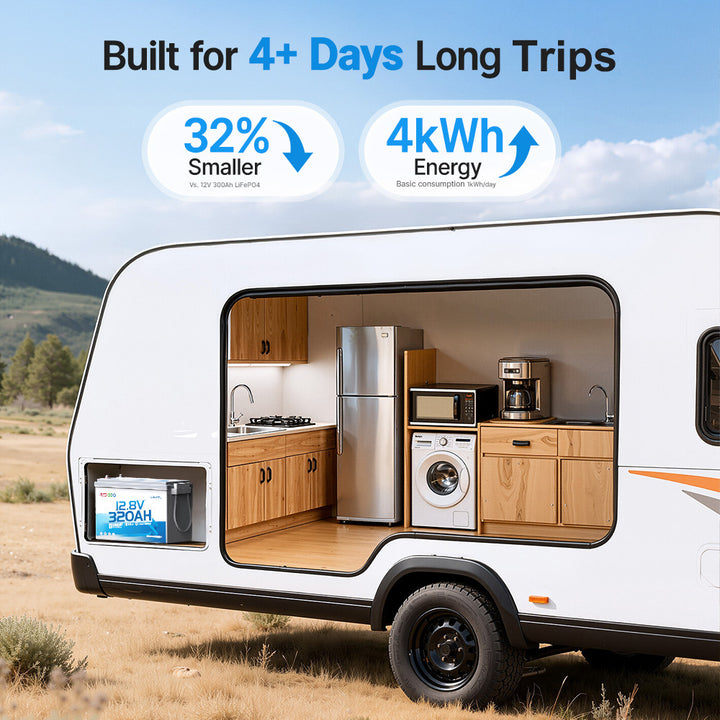
- 12V 320Ah Mini Bluetooth Lithium Battery – Combines high 4kWh of capacity with smart Bluetooth monitoring plus mini dimension. Ideal for boondocking, long road trips, desert trips, and full-time off-grid living.
Choosing the Right Battery Size Based on Your Camping Style
| Camping Style | Recommended Battery Size | Recommended Redodo Model |
|---|---|---|
| Weekend camping with hookups | 100Ah lithium | • 12V 100Ah Group 24 Bluetooth Battery • 12V 100Ah Group 31 Bluetooth Battery |
| Weekend boondocking | 140Ah lithium | • 12V 140Ah Group 31 Bluetooth Battery |
| Multi-day off-grid trips | 165Ah–200Ah lithium | • 12V 165Ah Group 31 Bluetooth Battery • 12V 200Ah Plus Deep Cycle Lithium Battery |
| Full-time off-grid living | 300Ah+ lithium | • 12V 300Ah Lithium Battery • 12V 320Ah Mini Bluetooth Lithium Battery |
Tips: The more electrical appliances you use and the longer you camp without hookups, the more amp-hours you’ll need.
FAQs of Travel Trailer Batteries
Is 100Ah enough for a travel trailer?
For most small and medium travel trailers, a 100Ah lithium battery is enough for basic appliances and short off-grid stays.
Can I run an air conditioner on a travel trailer battery?
For daily use, you may need a high-capacity lithium battery or multiple batteries in combination to handle the load safely, because AC units usually draw high power.
Can I connect multiple 2 or 3 batteries in parallel to increase capacity?
Yes, connecting batteries in parallel increases total amp-hour capacity while keeping voltage the same. This is a common approach for longer off-grid trips, but make sure all batteries are of the same type, age, and capacity for safe and balanced performance.
Are lithium batteries better than AGM for travel trailers?
Lithium batteries generally outperform AGM in terms of usable capacity, weight, lifespan, and charging speed. While they cost more upfront, lithium batteries are ideal for off-grid or heavy-use travel trailers, offering more convenience and long-term savings.
Conclusion
Choosing the right battery for your travel trailer is essential for a reliable and enjoyable camping experience. By understanding your daily power needs, calculating amp-hours or watt-hours, and selecting the appropriate battery group size, you can ensure your trailer stays powered.
Redodo offers a range of high-quality lithium batteries for every trailer size and camping style, combining long-lasting performance, Bluetooth monitoring, and hassle-free maintenance. With the right battery, you can focus on the adventure and leave power worries behind.

Read More:
What is the Best Battery for Travel Trailer?
How Long Will a 100Ah Lithium Battery Run a 12V Fridge?
What Size Battery Do I Need for My Camper? RV Battery Size Chart

Redodo
Redodo
Join Redodo
Related Post

What is SOC in Lithium Battery and Why Does It Matter?

Best Portable Battery for Overlanding 2026: Buyer’s Guide

How to Live in an RV Full-Time: A Complete Beginner’s Guide

How To Test a Battery with a Multimeter? (Step-by-Step)

5 Best 48V Lithium Batteries for Golf Cart in 2026
Related Products

Redodo 12V 100Ah Group 24 Bluetooth LiFePO4 Battery | Real-Time Battery Monitoring | For RV, Marine, Solar

Redodo 12V 100Ah Group 31 Bluetooth Lithium Battery | Real-Time Battery Monitoring | For RV, Marine, Solar

Redodo 12V 100Ah Ultra-Mini Lithium LiFePO4 Battery | Smallest Bluetooth Battery | For RV, Trolling Motor, Solar


Redodo 12V 200Ah Plus LiFePO4 Deep Cycle Lithium Battery | 2560W Load Power | For Solar Home, RV, Marine

Redodo 12V 320Ah Mini Bluetooth Lithium Battery | Best for Boondocking, Long Road Trip, Desert Trip, Home Backup

Redodo 12V 300Ah Lithium LiFePO4 Battery | Replaces 6*12V 100Ah AGM Batteries | For RV, Marine, Home battery backup