36V vs. 48V Battery for Golf Cart: Which Is Better?
If you own a golf cart, choosing the right battery system is one of the most important decisions you will make. The battery affects speed, torque, driving range, battery lifespan, and maintenance costs. Most golf carts arrive with either a 36V or 48V battery configuration, and the debate of 36V vs. 48V golf cart often comes down to performance needs, usage habits, and cost.
In this article, we’ll compare 36V and 48V golf cart systems, explain how voltage impacts performance, and help you decide which is right for you.
Takeaways
While a 36V golf cart system may be cheaper upfront and sufficient for flat courses or light use, a 48V battery system provides superior acceleration, power, efficiency, and terrain performance, making it the smarter choice for most golfers and outdoor enthusiasts.
Table of Content
- Understanding Golf Cart Battery Voltage
- 36V vs 48V Golf Cart System: What Are the Differences?
- Is a 48V Lithium Golf Cart Battery Better Than 36V?
- Can I Convert a 36V Golf Cart to a 48V Golf Cart?
- How Long Does A 48V Golf Cart Battery Last?
- Lead-Acid vs. Lithium Battery for Golf Cart
- Conclusion: 36V vs. 48V Golf Cart
Understanding Golf Cart Battery Voltage
Voltage determines how many electrical “push units” are available to deliver power to the motor. Higher voltage systems provide more efficient electrical output, allowing a cart to draw less current while maintaining or improving total performance.
In golf carts, the system voltage doesn’t tell you battery capacity (Ah) or range on its own, but it does directly influence:
- Acceleration and torque
- Top speed
- Motor power
- Energy efficiency
- Heat buildup and wear
Lower voltage systems draw higher amps to produce the same power. Higher voltage systems deliver more power with lower current, resulting in less strain and better long-term reliability.
This is why, under identical usage conditions, a 48V lithium battery system usually feels smoother and more powerful than a 36V lithium battery setup.
36V vs 48V Golf Cart System: What Are the Differences?
Although both 36V and 48V configurations can power a golf cart effectively, the overall driving experience, maintenance needs, energy efficiency, and upgrade potential differ dramatically. Below are the key areas where these two platforms diverge.
1. Power Output and Energy Delivery
A 36V golf cart uses fewer battery cells (often six 6V or three 12V batteries), while a 48V setup uses more cells (such as eight 6V batteries or four 12V batteries). The result is not just a voltage difference—it changes how energy is delivered.
A 48V system delivers the same output with less current, leading to:
- Less heat
- Lower energy loss
- Reduced burden on the wires, controller, motor, and battery pack
This translates directly into real-world performance: the 48V cart simply works less hard to do the same job. It’s like carrying the same bucket of water up to the seventh floor, someone stronger can get it done with a lot less effort.
2. Speed and Acceleration
While top speed depends on motor type, controller, tire size, and cart design, voltage is still one of the biggest influencers.
36V golf carts:
- Typically designed for standard course cruising
- Frequently top out around 12–14 mph
- Slower acceleration when carrying passengers or climbing inclines
48V golf carts:
- Better torque delivery
- Faster acceleration from a stop
- Capable of 15–20+ mph depending on motor/controller
The 48V system maintains performance under strain, keeping the cart responsive even as battery capacity drops.
3. Range and Efficiency
Voltage affects how efficiently a cart converts stored energy into movement. Generally, 48V carts typically travel farther per charge than 36V carts using the same battery chemistry and Ah capacity.
And when paired with a 48V lithium golf cart battery:
- The voltage curve stays flatter
- Power remains consistent until the pack is nearly empty
- No sluggish “lead-acid fade” at low battery levels
4. Initial Cost and Lifetime Cost
A 48V golf cart system is generally more expensive upfront than a 36V system because it requires more or higher-capacity components. However, it delivers better performance, greater efficiency, and a longer driving range, which can make it more cost-effective over time.
On the other hand, a 36V system is cheaper initially, with lower costs for batteries and parts. But it provides less power, slower acceleration, and reduced efficiency, which may limit its usefulness and lead to higher costs in performance-limited scenarios.
In short, 48V golf carts usually cost more at purchase, but their long-term benefits—stronger performance, efficiency, and reliability, often outweigh the initial savings of a 36V system.
Related Reading: How Much Does it Cost to Replace Golf Cart Batteries?
5. Driving Experience
Owners often say this is the deciding factor:
- 36V carts feel “normal” on flat golf courses or short local loops.
- 48V carts feel “effortless” — responsive, smooth, and confident.
Acceleration, climbing, throttle reaction, and stopping all feel more controlled with 48V.
6. Weight Considerations
Even when using the same type of battery, 36V and 48V systems can differ in total weight. A 48V setup usually requires more cells or larger batteries to achieve the higher voltage, which can add weight compared to a 36V system.
On the other hand, at the same voltage and capacity, lithium batteries are about 50%–70% lighter than lead-acid batteries. For owners looking to lighten their carts and improve the driving experience, upgrading to lithium is the smarter choice.
7. Maintenance and Upgrade
48V systems deliver higher power and uses more battery packs, the components are under greater stress, which may result in more frequent maintenance. 36V systems require less maintenance. However, compared to lead-acid, lithium system requires minimum maintenance.
In terms of upgrading, while a 36V cart can be converted to 48V, starting with 48V avoids extra hassle and ensures smoother, more flexible performance.
The Comparison Chart of 36V vs. 48V Golf Cart
| Feature | 36V Golf Cart | 48V Golf Cart |
|---|---|---|
| Power & Efficiency | Higher current; more heat and energy loss | Lower current; less heat and energy loss; more efficient |
| Speed & Acceleration | Top speed ~12–14 mph; slower acceleration | Faster acceleration; top speed 15–20+ mph |
| Range | Shorter range | Longer range |
| Cost | Lower upfront cost; may cost more long-term in performance | Higher upfront cost; more cost-effective over time due to efficiency and durability |
| Driving Experience | Feels normal on flat courses | Feels smoother, more responsive, and confident |
| Weight | Lighter due to fewer batteries | Heavier with more batteries |
| Maintenance & Upgrades | Less maintenance; can be upgraded to 48V | More maintenance due to more batteries; easier upgrades and future-proof |
Is a 48V Lithium Golf Cart Battery Better Than 36V?
After comparing all categories, the answer is usually yes: 48V comes out ahead in almost every practical scenario.
- Faster Acceleration: The 48V system delivers higher low-end torque, allowing for quicker and smoother acceleration.
- Enhanced Power: With stronger overall power, a 48V cart can easily tackle hills and rough terrain, making it ideal for challenging conditions.
- Improved Efficiency: Because it draws less current to achieve the same output, a 48V system is more energy-efficient than a 36V system, often providing longer run-time per charge.
- Better Terrain Handling: The higher voltage improves off-road capability, making it easier to navigate hills, uneven ground, and rugged courses.

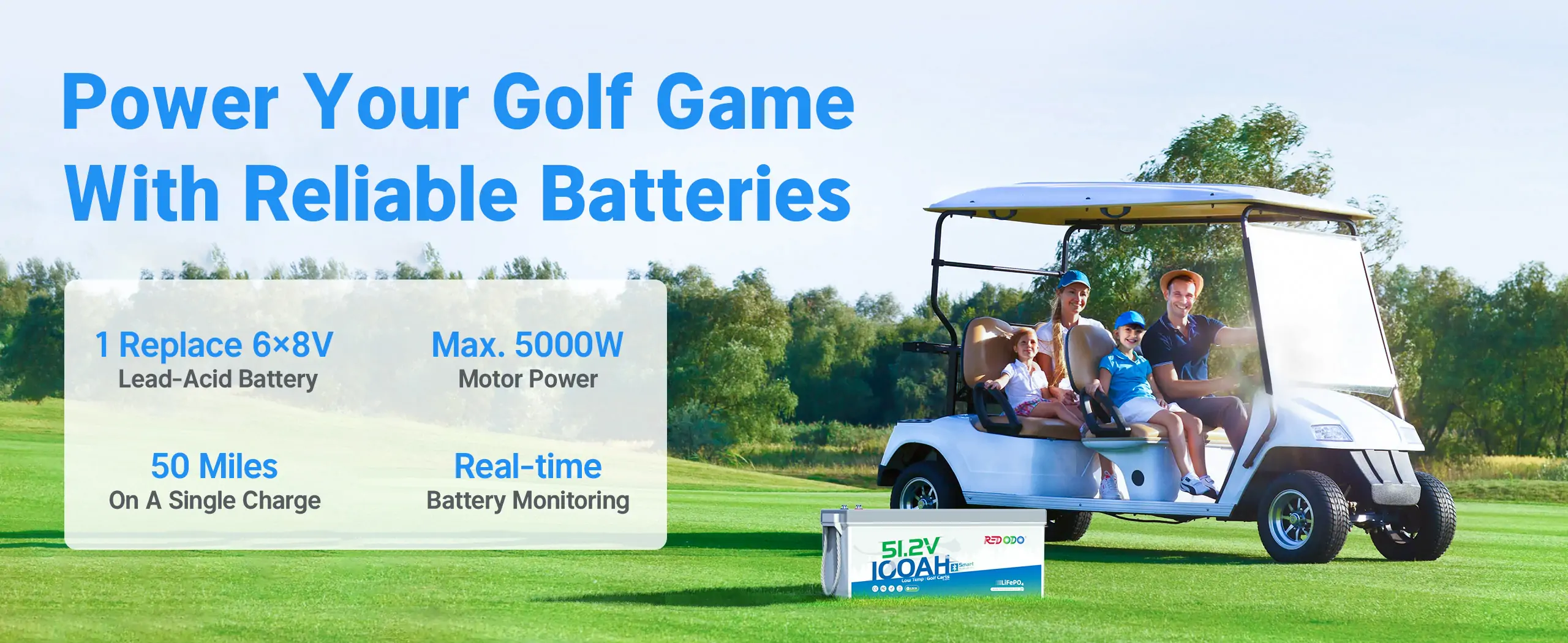
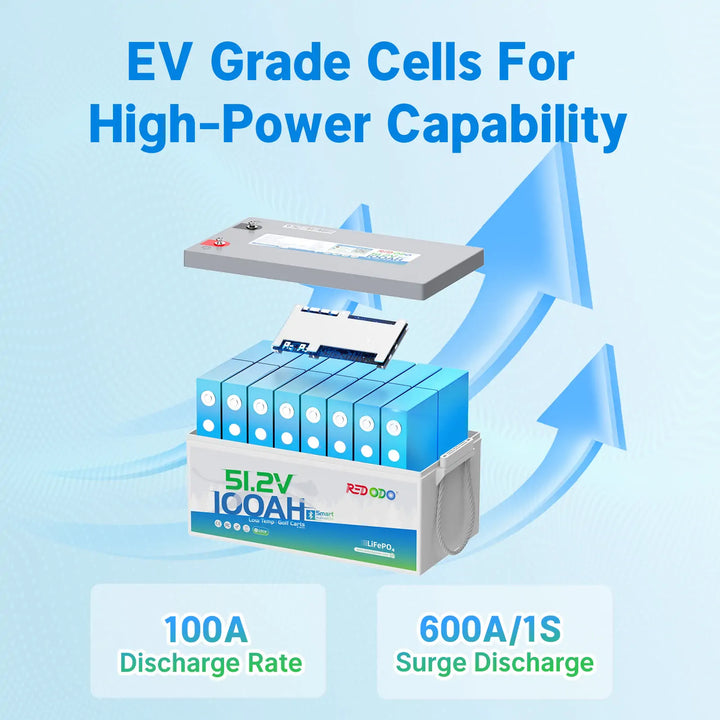
Redodo 48V 100Ah Lithium Golf Cart Battery
Can I Convert a 36V Golf Cart to a 48V Golf Cart?
Yes, and many owners do it! A conversion typically involves:
- Battery Upgrade: You’ll need a 48V battery pack to replace the existing 36V setup.
- Controller and Motor: The motor controller must be compatible with 48V, and in some cases, the motor may also need upgrading to handle the higher voltage.
- Wiring and Safety: Ensure all wiring, fuses, and connectors can safely support the increased voltage. Improper upgrades can cause overheating or damage.
A conversion can dramatically improve your cart’s performance, providing faster acceleration, stronger torque, and better hill-climbing ability. However, it is generally more cost-effective and less hassle to start with a 48V system if you’re planning an upgrade for long-term use.
Check out our 48V golf cart lithium battery conversion kit and upgrade your cart power now!

How Long Does A 48V Golf Cart Battery Last?
The lifespan of a 48V golf cart battery depends on battery type, usage, and maintenance:
- 48V Lithium (LiFePO4) Batteries: Typically last 4,000–6,000+ cycles, which can translate to 8–10 years or more under normal use. Lithium batteries are maintenance-free and maintain consistent voltage until nearly depleted, offering reliable performance over time.
- 48V Lead-Acid Batteries: Usually last 3–5 years with proper care, including watering, cleaning, and balancing. Performance gradually declines over time, and deep discharges can shorten lifespan.
In general, lithium 48V batteries are the better choice for longevity, efficiency, and consistent performance, especially if you plan to use your golf cart frequently or in challenging terrains.
Read More: How Long Do 48 Volt Lithium Golf Cart Batteries Last?
Lead-Acid vs. Lithium Battery for Golf Cart
Both 36V and 48V cart systems historically used lead-acid batteries. Today, lithium (LiFePO4) is a proper upgrade, especially for 48V lithium setups.
In lead-acid setups:
- Much heavy that affects the cart load and speed
- 36V packs often require more maintenance (watering, corrosion cleaning)
- Performance drops sharply as they discharge
- Capacity deteriorates quickly after 200–300 deep cycles
In lithium setups:
- Lighter than lead-acid and improve ride experience
- Capacity remains stable
- No maintenance
- Voltage consistency leads to longer range and better torque
- Lifespan typically 3–4× longer
Lithium upgrades work for both 36V and 48V carts, but the benefits of lithium compound when paired with a 48V platform, making it lighter, faster, and more efficient.
For anyone who uses their cart beyond basic golfing—camping, neighborhoods, RV resorts, trails, beaches, or towing—there is no realistic reason to choose 36V over 48V lithium.
Conclusion: 36V vs. 48V Golf Cart
While 36V golf carts are affordable and fine for casual, flat-course driving, 48V golf carts clearly offer superior performance, efficiency, and versatility. With faster acceleration, stronger power, better hill-climbing, and longer range, 48V systems, especially lithium batteries, provide the best overall experience.
For those who want a golf cart that performs reliably in real-world conditions and lasts longer, upgrading to a 48V lithium setup is the smartest choice.
Read More:
How To Convert Your Golf Cart to Lithium Batteries?

Redodo
Redodo
Join Redodo
Related Post

What is SOC in Lithium Battery and Why Does It Matter?

Best Portable Battery for Overlanding 2026: Buyer’s Guide

How to Live in an RV Full-Time: A Complete Beginner’s Guide

How To Test a Battery with a Multimeter? (Step-by-Step)

5 Best 48V Lithium Batteries for Golf Cart in 2026
Related Products

Redodo 48V(51.2V) 100Ah Lithium Golf Cart Bluetooth Battery | Replaces 6x 8V(or 8x 6V) lead-acid batteries | For Club Car, EZGO, ICON, Yamaha

Redodo 48V(51.2V) 100Ah Bluetooth Golf Cart Lithium Battery Conversion Kit | For Club Car, EZGO, ICON, Yamaha

⚡【Falsh Sale】Redodo 36V 50Ah Lithium Trolling Motor Battery for 36V Trolling Motors with 100-120 lbs

⚡【Flash Sale】Redodo 12V 100Ah Ultra-Mini Lithium LiFePO4 Battery | Smallest Bluetooth Battery | For RV, Trolling Motor, Solar

Redodo 12V 100Ah LiFePO4 Lithium Battery | Best Budget | For RV, Solar, Trolling Motor

Redodo 12V 100Ah Group 31 Bluetooth Lithium Battery | Real-Time Battery Monitoring | For RV, Marine, Solar

⚡【Flash Sale】Redodo 12V 100Ah Group 24 Bluetooth LiFePO4 Battery | Real-Time Battery Monitoring | For RV, Marine, Solar

Redodo 12V 100Ah Self-Heating Lithium Battery | For RV, Boats, and Solar Home Systems