What is the Best Battery for Yamaha Golf Carts?
Choosing the best battery for a Yamaha golf cart can dramatically improve performance, range, charging speed, and long-term ownership costs. Whether you're using your cart on the golf course, in a gated community, at a campground, or for light utility work, upgrading the battery is one of the most impactful decisions you can make.
In this guide, we’ll break down what type of battery works best, what to look for in a replacement, and the best 48V battery option for Yamaha golf cart.
Table of Content
What to Consider When Choosing Batteries for Yamaha Golf Cart?
Battery Voltage
Voltage must match your cart’s system requirements. Most modern Yamaha golf carts run on 36V or 48V systems, with 48V being the most common in newer models like the Drive, Drive2, and G-series.
Battery Capacity
Capacity determines how far you can drive on a single charge. For most Yamaha users, 100Ah offers an excellent balance between range and efficiency, which is ideal for extended range, hills, or heavier loads.
Battery Type
Lead-acid and lithium are two primary options for Yamaha golf carts. The battery type impacts your battery lifespan, performance, maintenance, and total cost of ownership.
Battery Weight
Weight directly affects acceleration, climbing power, tire wear, and overall efficiency. For example, traditional lead-acid battery sets can weigh 300–400+ lbs combined. A 48V lithium battery system can reduce total weight by 200–300 lbs.
Maintenance Requirement
Maintenance is often overlooked but crucial. Flooded lead-acid batteries require regular watering and maintenance. AGM reduces some maintenance but still degrades over time. Lithium batteries are maintenance-free.

Battery Types of Yamaha Golf Cart: Lead-Acid and Lithium
Lead-acid batteries have been the traditional standard for golf carts for decades. They are available in two main types: Lead-acid (FLA, AGM) and lithium (LiFePO4).
Flooded Lead-Acid Golf Cart Batteries
These are the most common and affordable option.
Advantages:
- Lower upfront cost
- Widely available
Disadvantages:
- Much heavy
- Requires regular watering
- Susceptible to corrosion
- Voltage drops as charge decreases
- Shorter lifespan (typically 3–5 years)
- Slower charging
AGM Golf Cart Batteries
AGM (Absorbent Glass Mat) batteries are sealed lead-acid batteries designed to reduce maintenance.
Advantages:
- Spill-proof
- Lower maintenance than flooded
- More vibration resistant
Disadvantages:
- Still heavy
- More expensive than flooded
- Limited cycle life
- Sensitive to overcharging
Lithium Golf Cart Batteries
Lithium golf cart batteries represent the modern evolution of golf cart power systems.
Advantages:
- Longer lifespan than FLA and AGM
- Stable power output
- Maintenance-free
- Lightweight design
- Fast charging
Disadvantages:
- Higher initial cost than lead-acid
Recommended Lithium Golf Cart Battery for Yamaha
For Yamaha golf cart owners looking for long-term value, lithium is often the superior investment.
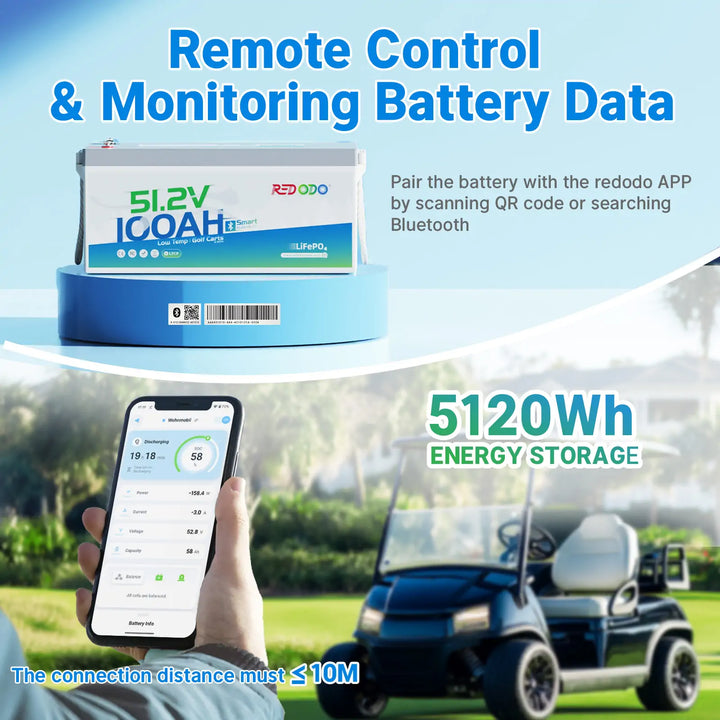
If you’re looking for a powerful, long-lasting solution, the Redodo 48V 100Ah Lithium Golf Cart Battery is one of the most practical upgrades available.
Why Redodo 48V 100Ah is Ideal for Yamaha Golf Carts?
48V System Compatibility
The Redodo 48V 100Ah lithium battery is engineered specifically for 48V golf cart systems. This direct voltage compatibility ensures seamless integration with your cart system without complex modifications. A single 48V lithium unit instead of wiring multiple 6V or 8V lead-acid batteries in series.
High 100Ah Capacity
With a high 100Ah capacity, this battery provides up to 50 miles of extended driving range on a single charge. Higher amp-hour capacity translates to longer runtime per charge, meaning fewer interruptions and less frequent charging.
Lightweight Design
Traditional lead-acid battery sets can weigh over 300 lbs combined. In contrast, the Redodo 48V lithium battery weighs only 82 lbs. This weight reduction improves acceleration, torque, and energy efficiency while improving your driving experience.
Built-in Advanced BMS
The battery features an advanced Battery Management System (BMS) that actively monitors and protects the cells during operation. The upgraded BMS is equpped with smart Bluetooth for real-time monitoring and 20+ protections for stable performance.
Maintenance-Free
Unlike flooded lead-acid batteries that require regular watering and terminal cleaning, lithium batteries are completely maintenance-free. This eliminates routine maintenance tasks and reduces the risk of performance issues caused by neglect.
Fast Charging Support
When paired with a compatible 48V lithium charger, the Redodo 48V 100Ah battery can recharge in just a few hours, ensuring your cart is ready whenever you need it.
Longer Lifespan
With EV-grade LiFePO4 cells, the battery can deliver 4,000+ charge cycles. The longer lifespan significantly lowers total cost of ownership over time and reduces the frequency of replacements.
Compatible With Yamaha, EZGO & Club Car
Beyond Yamaha, this Redodo lithium golf cart battery is also compatible with major golf cart brands such as EZGO and Club Car. If you ever switch cart brands, your battery investment can often move with you, adding long-term flexibility and value.

Check out the 48V Golf Cart Lithium Battery Conversion Kit for one-stop lithium upgrade and saving more!

Choosing a 48V Battery Charger for Yamaha Golf Cart
One of the key advantages of upgrading to lithium is dramatically faster charging. By choosing the right 48V battery charger for your Yamaha golf cart, you can significantly reduce downtime and spend less time waiting and more time back on the course.
The Redodo 58.4V 18A LiFePO4 Battery Charger is purpose-built for 48V lithium golf cart batteries. It can fully charge a 48V 100Ah lithium golf cart battery in just about 5.6 hours. The charger is also equipped with multiple built-in safety protections to ensure safe and reliable operation.

Related Reading: Can I Charge LiFePO4 Battery with a Normal Charger?
FAQs about Yamaha Golf Cart Batteries
How long does a Yamaha golf cart battery last?
The lifespan of a Yamaha golf cart battery depends largely on the battery type and how well it is maintained. Traditional lead-acid batteries typically last around 3–5 years. In contrast, lithium batteries can last 8–10 years or more, delivering over 4,000 charge cycles under normal conditions. Driving habits, terrain, charging practices, and maintenance routines all play a major role in determining actual lifespan.
Can I put 4 12-volt batteries in my 48-volt golf cart?
Yes, technically you can use four 12V batteries wired in series to create a 48V system, as long as they are specifically designed for golf cart use. However, it's not recommended because the voltage balance among the four 12V batteries and the motor power requirements may not be sufficient for 48V carts. Many golf cart owners prefer either six 8V batteries, eight 6V batteries, or a single 48V lithium battery pack for better balance, performance, and simplified wiring.
Related Reading: Can I Use 4 12-Volt Batteries in A 48 Volt Golf Cart?
Are lithium batteries worth it in golf carts?
For most users, lithium batteries are absolutely worth the investment. While the upfront cost is higher than lead-acid batteries, lithium offers significantly longer lifespan, faster charging, lighter weight, zero maintenance, and more consistent performance. Over time, the lower cost per cycle and reduced replacement frequency often makes lithium more economical in the long run, especially for frequently used Yamaha golf carts.
How to extend my golf cart battery life?
To maximize battery lifespan, always use the correct charger, avoid deep discharging whenever possible, and charge the battery fully after each use. For lead-acid batteries, maintain proper water levels, clean terminals regularly, and perform equalization charging when recommended. For lithium batteries, ensure proper storage in moderate temperatures.
Conclusion
Choosing the best battery for your Yamaha golf cart comes down to performance needs, maintenance preferences, and long-term value. It’s important to evaluate key factors such as battery type, system voltage, capacity (Ah rating), overall weight, and maintenance requirements.
For Yamaha owners seeking a powerful, reliable, and maintenance-free upgrade, the Redodo 48V 100Ah golf cart lithium battery offers the ideal balance of range, durability, and convenience.
With faster charging, consistent power output, and compatibility across major brands like Yamaha, EZGO, and Club Car, upgrading to lithium is not just a replacement, it’s a long-term performance investment.
Read More:
How Much Does it Cost to Replace Golf Cart Batteries?
How To Convert Your Golf Cart to Lithium Batteries?

Redodo
Redodo
Join Redodo
Related Post

What Are Street Legal Requirements for Golf Carts?

What is SOC in Lithium Battery and Why Does It Matter?

Best Portable Battery for Overlanding 2026: Buyer’s Guide

How to Live in an RV Full-Time: A Complete Beginner’s Guide

How To Test a Battery with a Multimeter? (Step-by-Step)
Related Products

🎃【SAVE $125】Redodo 48V(51.2V) 100Ah Lithium Golf Cart Bluetooth Battery | Replaces 6x 8V(or 8x 6V) lead-acid batteries | For Club Car, EZGO, ICON, Yamaha

🎃【SAVE $80】Redodo 48V(51.2V) 100Ah Bluetooth Golf Cart Lithium Battery Conversion Kit | For Club Car, EZGO, ICON, Yamaha


Redodo 12V 100Ah Group 24 Bluetooth LiFePO4 Battery | Real-Time Battery Monitoring | For RV, Marine, Solar

🎃【SAVE $20】Redodo 12V 100Ah Ultra-Mini Lithium LiFePO4 Battery | Smallest Bluetooth Battery | For RV, Trolling Motor, Solar