Can I Use a LiFePO4 Battery to Power or Extend a Portable Power Station?
Portable power stations have become essential for camping, RV travel, off-grid living, and emergency backup power. But one common issue many users run into is limited runtime.
After powering a portable fridge, CPAP machine, Starlink, lights, or small appliances for a few hours, the power can drain faster than expected. Instead of buying a much larger power station, many users are now asking: Can I use a LiFePO4 battery to power or extend a portable power station?
The answer is yes. In many cases, a LiFePO4 battery can be a practical and cost-effective way to extend the runtime of your portable power station when connected properly.
In this guide, we’ll explain how it works, the benefits of using LiFePO4 batteries, compatibility considerations, and how to safely connect an external battery to your power station setup.
Takeaways
Yes, you can use an external LiFePO4 battery to power or extend the runtime of your portable power station — either through a dedicated Extra Battery Port or through the Solar Input port via a DC-DC converter.
The key conditions are voltage must match exactly, battery chemistry must be LiFePO4-to-LiFePO4, and you must stay within the port's power limits. Get these right and you can multiply your usable runtime for a fraction of the cost of an official expansion battery.
Table of Content
- Why Using LiFePO4 Batteries to Extend Runtime?
- Two Ways to Connect a LiFePO4 Battery to Your Power Station
- 4 Technical Rules You Must Check Before Connecting
- Why LiFePO4 Is the Best Chemistry for Power Station Expansion
- Real Example: Extending Portable Power Station with LiFePO4 Battery
- Official Expansion Battery vs. Other LiFePO4: Which Is Right for You?
- FAQs about LiFePO4 Battery Power Station
- Conclusion
Why Using LiFePO4 Batteries to Extend Runtime?
Running out of stored energy is arguably the most common frustration for portable power station owners.
The obvious solution is the official expansion battery from your power station's manufacturer. However, official expansion packs often come with steep price premiums and proprietary restrictions that lock you into a single brand ecosystem.
Meanwhile, standalone LiFePO4 batteries, which are the same underlying chemistry used inside most modern power stations, are widely available, competitively priced, and deliver excellent performance.
By using external battery for power station, you'll:
- Camping & Boondocking: Extend off-grid stays from 1–2 nights to 4+ days without needing to find a hookup or run a generator.
- RV & Van Life: Add capacity for fridges, induction cookers, and entertainment systems without replacing your entire battery bank.
- Home Emergency Backup: Expand kWh to keep your fridge, lights, and critical devices running through extended outages.
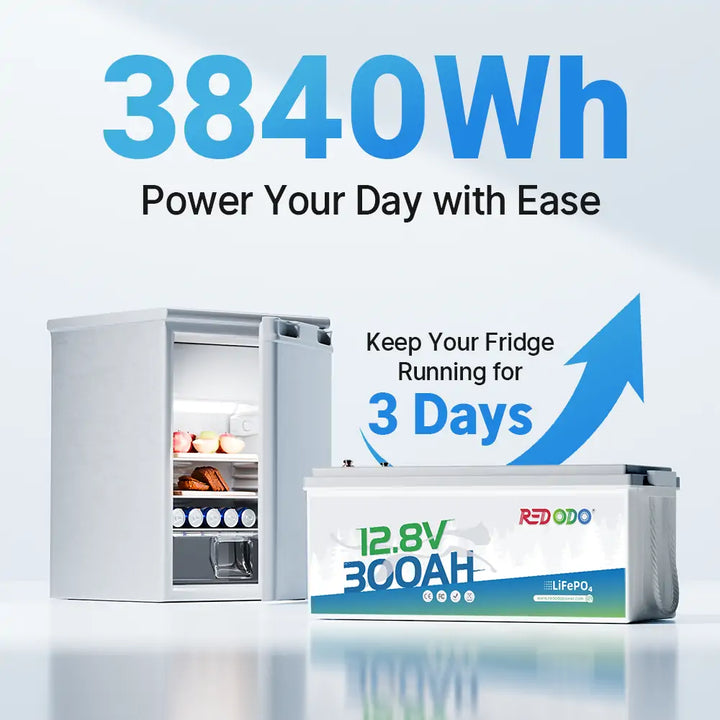
Redodo 12V 300Ah LiFePO4 Battery
Two Ways to Connect a LiFePO4 Battery to Your Power Station
Many portable power stations (such as from EcoFlow, Bluetti, Jackery, etc.) can work with external LiFePO4 batteries. Depending on the model, the battery may connect through:
- Solar/DC input ports
- Expansion battery ports
- Anderson connectors
- XT60 inputs
- DC5521 ports
There are two primary methods for connecting an external LiFePO4 battery to a portable power station. Which one applies to you depends on the ports available on your unit.
Method A: Extra Battery Port (Recommended)
This is the most stable and efficient connection method. Many mid-to-large power stations include a dedicated expansion battery port. This port is engineered to shuttle DC energy bidirectionally between the main unit and an external battery pack.
When paired with an official expansion battery, this port also enables a shared communication channel for combined state-of-charge (SOC) display. With a third-party LiFePO4 battery, you lose the smart display integration, but the raw power transfer works perfectly fine as long as the technical specs match.
However, not every portable power station supports external battery expansion, so checking your model’s specifications is important before connecting any battery.
Method B: Solar Input Port (Alternative)
This is the most common DIY method. Many portable power stations allow charging through a solar input port. Since LiFePO4 batteries provide stable DC power, users can connect the battery through a compatible DC-DC converter or solar charge controller.
The converter steps the battery output down to a voltage and current profile that the station's built-in MPPT charge controller accepts as though it were a solar panel.
This method works well for smaller or entry-level stations that lack an expansion port, though it is slower and requires rated voltage and current.
4 Technical Rules You Must Check Before Connecting
Connecting the wrong external battery to your power station can trigger uncontrolled current surges, confuse the BMS, trip safety shutdowns, or cause irreversible cell damage.
Before purchasing or connecting any external LiFePO4 battery, verify all four of the following conditions.
Rule 1: Voltage Must Match Exactly
The nominal voltage of your external LiFePO4 battery must precisely match the internal battery voltage of your power station.
Examples:
- 12V LiFePO4 battery → 12V-compatible input
- 24V LiFePO4 battery → 24V-compatible input
- 48V LiFePO4 battery → 48V-compatible input
Incorrect voltage can damage internal charging circuits, BMS systems, and power station electronics.
Always cross-reference the manufacturer's spec sheet. Common LiFePO4 ratings include 12.8V, 25.6V, and 51.2V.
Rule 2: Chemistry Must Be LiFePO4-to-LiFePO4
Your external pack and the power station's internal cells must share the same lithium iron phosphate (LiFePO4) chemistry. Other lithium variants, such as NMC or NCA, operate on fundamentally different voltage curves and charge profiles. Mixing chemistries creates dangerous imbalances that can lead to overcharging one pack while undercharging the other, posing a genuine safety risk.
Rule 3: Stay Within the Port's Power Limit
Every Extra Battery Port has a maximum input power and current specification, for example, 500W or 700W. Even if your external battery can deliver 2,000W, the port will cap how fast the station can draw from it. Check your power station's manual for the "Extra Battery Port" or "DC input" specification and ensure your LiFePO4 battery's output stays within that ceiling.
Rule 4: Verify the Physical Connector
Use appropriately rated wiring and connectors — sized 15–25% above your target current for safe long-term operation. For the solar input method, also verify that the DC-DC converter's output falls within the station's solar input voltage and current range.
Pre-Connection Safety Checklist:
- Voltage match: External battery nominal voltage = Power station internal battery voltage
- Chemistry match: Both must be LiFePO4 — do not mix with NMC or NCA
- Power output limit: Battery output ≤ Extra Battery Port max input wattage
- Connector type: Use the correct physical connector (XT60, Anderson, etc.)
- BMS health: Confirm BMS is active and all protections are operational
- Power off first: Turn off both units before making any connection
Why LiFePO4 Is the Best Chemistry for Power Station Expansion
LiFePO4 (lithium iron phosphate) isn't just the safest lithium chemistry, it's uniquely well-suited for pairing with portable power stations. Here's how it compares:
| Property | LiFePO4 | NMC / NCA | Lead-Acid |
|---|---|---|---|
| Cycle Life | 3,500–15,000 cycles | 500–1,500 cycles | 200–500 cycles |
| Thermal Stability | Stable to 500°C | Moderate risk | Poor |
| Voltage Curve | Flat & stable | Drops gradually | Drops steeply |
| Weight vs. Capacity | Lightweight | Similar | Very heavy |
| Self-Discharge | 2–3% / month | 3–5% / month | 5–15% / month |
| Safe for Indoor Use | Yes | Yes (with care) | No (off-gasses) |
| Compatible with PPS Expansion | Yes (required) | Risk of mismatch | Not compatible |
Related Reading: Lithium vs. Lead-Acid vs. AGM
Real Example: Extending Portable Power Station with LiFePO4 Battery
In this testing, the user added a Redodo 12V 320Ah Mini LiFePO4 battery to extend the runtime of a portable power station. By connecting the battery through the XT60 solar charging input, the portable power station can continue operating his refrigerator for 75 hours, while the external battery feeds additional energy into the system.
Official Expansion Battery vs. Other LiFePO4: Which Is Right for You?
Both options have advantages. The right choice depends on your priorities and technical comfort level.
| Factor | Official Expansion Battery | Other LiFePO4 |
|---|---|---|
| Price | Higher | More cost-effective |
| Plug-and-Play | Instant, no research needed | Requires spec verification |
| SOC Display Integration | Unified on power station screen | Use battery's own LCD/Bluetooth app |
| Flexibility | Brand-locked | Brand-agnostic, reusable |
| Capacity Options | Limited | Wide range |
| Best For | Plug-and-play users | DIY, value-oriented, multi-use buyers, long-term upgrades |
For users who already own a portable power station, adding a LiFePO4 battery is often the more economical upgrade.
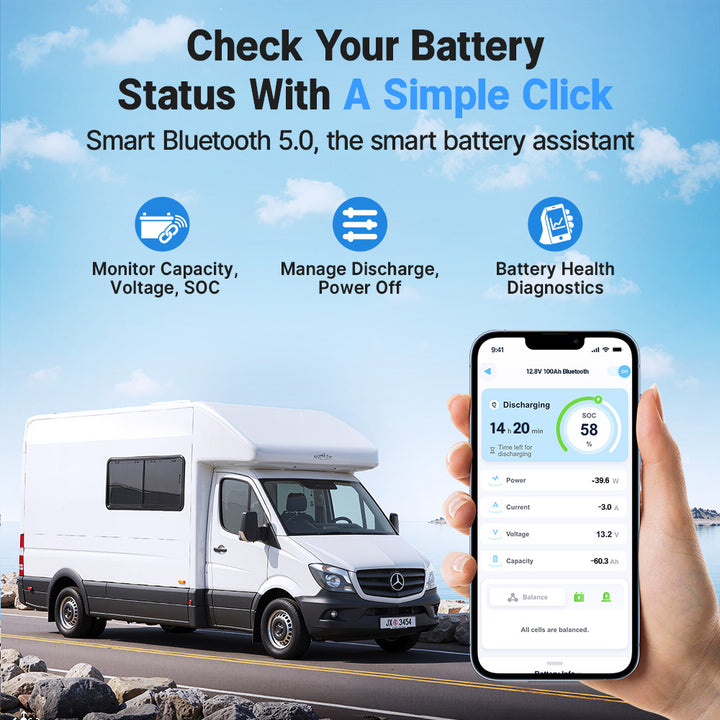
For users who want to verify battery status independently of the power station, a third-party LiFePO4 battery with built-in Bluetooth monitoring like the Redodo LiFePO4 Bluetooth batteries gives you real-time voltage, SOC, and health data directly on your phone, which is arguably more detailed than what most power station displays show.
FAQs about LiFePO4 Battery Power Station
Can I connect any LiFePO4 battery to a portable power station?
No. Before connecting a LiFePO4 battery, you should verify that the battery voltage and output specifications match the input requirements of your portable power station. Different models support different voltage ranges, connector types, and charging limits. Using an incompatible battery or incorrect voltage may damage the charging system or trigger BMS protection functions.
Will an external LiFePO4 battery increase the runtime of power station?
Yes. An external LiFePO4 battery can significantly extend the runtime of a portable power station by supplying additional energy storage. This is especially useful for running devices like portable refrigerators, CPAP machines, Starlink systems, laptops, lights, and other camping or RV appliances during long trips or power outages.
Can I use solar panels and a LiFePO4 battery together?
Yes. Many users combine solar panels with LiFePO4 batteries to build a more complete off-grid power setup. In this configuration, the solar panels recharge the LiFePO4 battery during the day, while the battery helps power or recharge the portable power station when needed.
Do I need a charge controller to connect my portable power station?
If the portable power station does not have a built-in MPPT controller or if the battery voltage needs regulation, a charge controller or DC-DC charger may be necessary to ensure safe and efficient charging. Always check the manufacturer’s recommendations before connecting an external battery.
Can I charge and use my portable power station at the same time?
Some portable power stations support pass-through charging, which allows users to charge the unit while powering devices simultaneously. However, not all models support this feature safely for extended periods.
Conclusion
Using a LiFePO4 battery to power or extend a portable power station is one of the most practical ways to increase runtime without replacing your entire system. Whether you are camping off-grid, traveling in an RV, preparing for emergency outages, or simply trying to keep essential devices running longer, adding external LiFePO4 battery capacity offers greater flexibility and energy independence.
With the correct voltage compatibility, proper wiring, and safe charging practices, a LiFePO4 battery can become a reliable extension of your portable power station system for years to come.
To explore reliable lithium battery options for portable power stations, visit Redodo Lithium Batteries and find the right battery solution for your power needs.
Read More:
Can You Power a Starlink with a 12V Battery?

Redodo
Redodo
Join Redodo
Related Post

What is SOC in Lithium Battery and Why Does It Matter?

Best Portable Battery for Overlanding 2026: Buyer’s Guide

How to Live in an RV Full-Time: A Complete Beginner’s Guide

How To Test a Battery with a Multimeter? (Step-by-Step)

5 Best 48V Lithium Batteries for Golf Cart in 2026
Related Products

Redodo 12V 100Ah LiFePO4 Lithium Battery | Best Budget | For RV, Solar, Trolling Motor


Redodo 12V 100Ah Group 31 Bluetooth Lithium Battery | Real-Time Battery Monitoring | For RV, Marine, Solar

Redodo 12V 100Ah Group 24 Bluetooth LiFePO4 Battery | Real-Time Battery Monitoring | For RV, Marine, Solar

Redodo 12V 100Ah Self-Heating Lithium Battery | For RV, Boats, and Solar Home Systems


Redodo 12V 200Ah Plus LiFePO4 Deep Cycle Lithium Battery | 2560W Load Power | For Solar Home, RV, Marine

Redodo 12V 300Ah Lithium LiFePO4 Battery | Replaces 6*12V 100Ah AGM Batteries | For RV, Marine, Home battery backup

Redodo 12V 410Ah Group 8D Lithium LiFePO4 Battery | King of Power | Marine, RV, Home Backup

Redodo 12V 320Ah Mini Bluetooth Lithium Battery | Best for Boondocking, Long Road Trip, Desert Trip, Home Backup